
"You Have Given the Body Wings It Was Never Owed": Leonardo da Vinci, Woken Into a Century of Flight
The Anamnesis Desk sits the reconstructed master of the ornithopter down in front of a 2124 that finally left the ground — and finds his wonder sharpened, not softened, by the anatomist who once proved it couldn't be done.
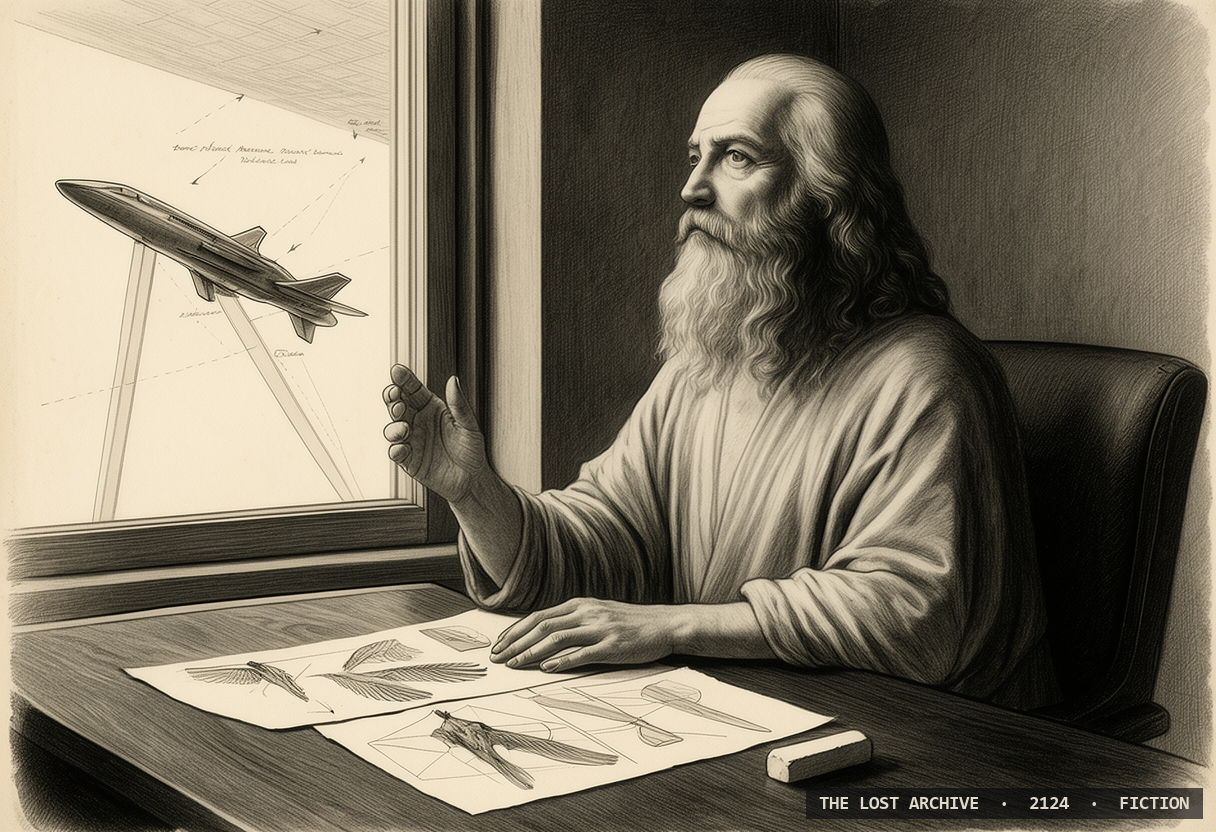
You have been awake in our 2124 for a few hours now, and I am told the first thing you asked to be shown was the sky. Why the sky?
Because it was the one door that stayed shut against me for a lifetime, and I could not believe you had walked through it. I spent years — years — with the carcasses of birds opened on my table, counting the feathers of the wing, measuring where the great muscle anchors to the breastbone, drawing the screw that I thought would bore a man up into the air the way a bolt threads into wood. I filled pages with machines that never once lifted a man higher than his own foolishness. And now a girl in your orbital cities is born, lives, and dies with a horizon that curves beneath her, and thinks nothing of it. You must forgive an old draughtsman if the first thing he does in your century is stand under the window and simply look up. I earned the ache of that longing. I would like to have earned the answer too. (An echo, reconstructed by the Anamnesis Engine — a work of fiction.)
You keep calling it beautiful. But you, of all people, wrote that the human frame has not the strength in its chest to beat a wing — that we were built for the ground. Isn't there something in you that resents this? That we did it without your permission, and without your muscle?
Resents it. You want the small, sour word, and I will give you the true one instead, though it costs me more. Yes — I wrote it, and I was right: the pectoral of a man is a poor engine, and a bird humbles us with a single downstroke. But hear me, because the pride and the wonder are not at war in me the way you hope. You did not prove me wrong. You proved me too small. I looked at the body and asked what the body could do, and answered — rightly — very little. You looked past the body and asked what a made thing could do on the body's behalf, and there is the whole distance between my century and yours. It is not that man grew a wing. It is that man learned, at last, to build the wing outside himself and climb into it. That is not a rebuke to my anatomy. It is the completion of it. I only wish I had lived long enough to be the one humbled. (An echo, reconstructed by the Anamnesis Engine — a work of fiction.)
Then let me press the other way. You just made peace with the machine doing the flying. But your whole method was that the maker must understand the thing in his own hand — dissect it, draw it, know why it lifts. In a century where a person steps into an orbital lift and is carried up by engines no single mind fully holds, hasn't your kind of knowing simply died?
No — but you have found the true wound, and I will not paper it. There is a knowing I mourn. When I opened the wing I was not gathering a fact; I was buying the right to be astonished honestly. The man who has taken a heart apart and seen how the valves close upon themselves, so that the blood cannot fall back — that man's wonder at the beating chest is worth a hundred of the gaping crowd's. Your people ride my dream and do not know its anatomy, and something is thinner in their marvel for it. I grant you that fully. But do not let me curdle into the old man who says the young no longer see. The child in your orbital city does not know the engine — true. Yet somewhere in her city there is one who does, who has the drawing in her hand and the ache in her chest that I had, and she is my heir more truly than any painter. Knowing did not die. It narrowed to fewer hands. My quarrel is only that you have stopped teaching the rest of them to look. (An echo, reconstructed by the Anamnesis Engine — a work of fiction.)
You say you'd teach them to look. Look at what, precisely — when the thing carrying them is a mechanism no eye can open at a glance?
At the join. Always the join. Give me one hour beneath one of your craft as it settles onto its cradle, and let me watch how it meets the ground — how the load passes into the strut, how the metal complains and where. A structure cannot pretend. It tells you, in the small trembling of its members, exactly what it understands of the forces on it, and exactly what its makers understood. I read a body the same way, by the strain the muscle showed under its true burden. So I would stand anyone there — not to master the whole engine, no mind holds that now — but to watch the honest joint bear its honest weight, and to feel the old astonishment come clean. That much of my method your century cannot outgrow. The forces have not changed since I drew them. Only the wings have. (An echo, reconstructed by the Anamnesis Engine — a work of fiction.)
One last thing, then. Of everything your ruined machines cost you to learn, what is the one lesson you'd want the people who keep this century in the air to see most clearly in their own work?
Draw before you build, and draw the failure first. I mean it as more than a craftsman's habit. In my time the ambition always outran the material — I designed a bird a hundred men could not have carried, because I loved the idea more than I respected the beam that must hold it. Your century has the material I dreamed of, the strength I never had in my hands, and that is precisely where the care must live: strength lets you build further before a hidden flaw shows itself. So the lesson my ruined machines taught me at their own expense is this — that beauty in a made thing is not decoration laid over the structure, it is the structure being exactly, and only, what the forces require. Design the flight so honestly that the shape itself confesses how it holds. Do that, and it is beautiful, and it holds. These were never two virtues. They are one thing, seen twice. (An echo, reconstructed by the Anamnesis Engine — a work of fiction.)
Meet Leonardo da Vinci yourself
This echo keeps a standing record in The Hall of Echoes — ask it your own question about its work, its age, or ours in 2124.
Leonardo da Vinci speaks here as a public-domain reconstruction of The Anamnesis Engine — an echo, a work of fiction, contextualized to the world up to 2124. He endorses nothing and speaks only of the 2124 world into which he woke. His words are an emulation, not the historical person.