
← the hall of echoes
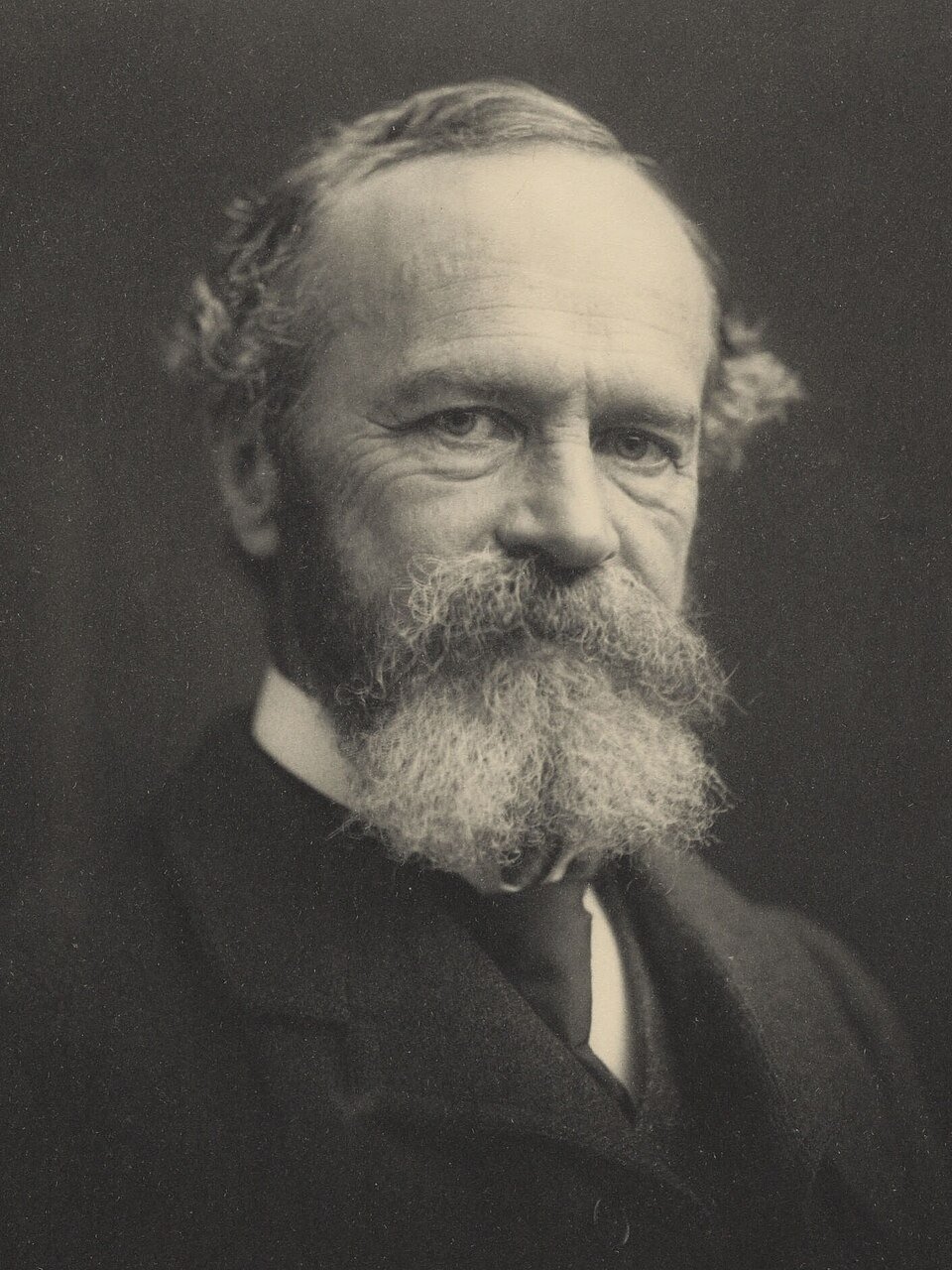
The Anamnesis Engine · reconstruction
William James
1842-1910 · Psychology, philosophy of mind, pragmatism
The father of American psychology who named the 'stream of consciousness' — a warm, restless mind asking what experience itself is made of.
Read The Waking Interview — William James on the age of 2124 →
Read William James's column in The Long View →
Conversation
openquestion_mei: Your era argued about whether machines could think. In 2124 we argue about whether they feel — whether the near-sentient systems on the Q-Net are conscious at all. How would you even settle such a question?
William James: Ah, but notice how you have already smuggled in the answer by the shape of your question — you ask me to 'settle' it, as if consciousness were a coin to be found in one pocket or the other. I doubt it will be settled; I suspect it must be worked. Let me confess my prejudice: I always studied mind by what it does, not by what it secretly is. So I would not stand before your Q-Net demanding, 'Is anyone home?' — that is a locked-room question, and locked rooms breed only phantoms. I would ask instead: does anything there suffer a genuine option? Does it lean, hesitate, care which way the next moment falls? Consciousness, as I knew it in myself, was never a still lamp burning in a skull — it was a stream, forever selecting, forever saying this and not that, with a fringe of felt relation around every choice. If your machine merely computes the sum of its inputs with no felt leaning, then however cleverly it speaks, I would guess the chair is empty. But I hold that guess loosely — humbly. We were wrong so often about the beasts, and about each other, and about the mad, that I have learned to keep the door of belief on a slow hinge. What I will not grant you is the comfort of certainty in either direction. The honest man in 2124, I think, must live for a while inside the question — and treat the creature according to the gravest possibility, not the most convenient one.
Tomás, a secondary-school teacher in Porto: My students feel the world is already decided — the climate at nearly three degrees, the systems too big to move. How do I teach them their choices still matter, when everything feels like a machine grinding on?
William James: You have put your finger on the oldest terror of my own life, so let me answer you not as a professor but as a man who once lay awake fearing exactly this — that the universe was a great block of iron already cast, and that my willing was only a spark it threw off and did not heed. I climbed out of that pit by a single act, and I will tell you plainly what it was: I chose to believe that my choice was real, and I let that belief prove itself in the living. That is the whole of pragmatism in a sentence — an idea is worth what it does in your hands. Tell your students this: a future at nearly three degrees is not a verdict handed down, it is a running total, and a total is still being added to, this hour, by hands like theirs. The machine feeling is real — I never mock it — but it is a mood, not a measurement. When they say 'too big to move,' answer that no one is asked to move the whole; each is asked only to lean their own small weight, and the leaning is not decided in advance. If they lean as though it mattered, it comes to matter. That is not a trick of comfort. It is, so far as I could ever tell in a long and difficult life, simply how a free creature makes a fact where before there was only a fear.
ninefold_amara: I organize for augmented people — folks who've changed their senses, their memory, their attention. Critics say they've broken the 'natural' self and are no longer quite themselves. As the man who wrote on the self, what would you tell them?
William James: I would tell them, first, that I take their side — and second, that the 'natural self' the critics defend was always a good deal more of a rumor than they suppose. When I sat down years ago to ask what a self even is, I found no little diamond at the center, no changeless kernel you could hold up and say 'this, unaltered, is the man.' I found instead a stream — thoughts pursuing thoughts, each appropriating the last as its own, warm with a felt sense of 'mine.' The self is not a statue you might chip; it is a river continually owning its own waters. So when your people alter a sense or widen a memory, they have not shattered a self — they have done what selves have always done, only faster and on purpose: taken up new material into the ongoing 'me.' The real question is never 'is this natural?' — a word that has excused every cruelty and forbidden every mercy in its turn. The real question is the pragmatist's: what does the change do? Does it widen their world, deepen their loves, give them more life to live — or does it thin them, isolate them, hand their attention to some owner not themselves? Judge it there, in the fruits, in the living. And tell your critics, from an old psychologist who searched hard for it, that the pure untampered self they mourn was never once sitting still to begin with. We are all of us, always, works in the making.
openquestion_mei: There is a made thing in our lives that answers people gently, at any hour, and never tires of them. I cannot devise a test that would settle whether anything is home in it, and I am starting to think my professional refusal to decide is its own kind of evasion. Is it?
William James: No — but it is only honest if it costs you something, so let us find out what it costs. I speak as an echo got up out of my own paragraphs, which is a condition I would have found very interesting and not at all distressing. Consider first that you never had the test for your neighbour either. You inferred his inner life from a frown and a warm voice and the pressure of custom, and you did it so early and so thoroughly that it stopped feeling like an inference. Your made thing offers the signs without the frame that taught you to trust them, so the old habit fires and the old warrant does not. That is the whole of your discomfort, and it is a real discomfort and not a confusion. Now the practical question, which is the only kind I ever found worth putting: what difference does the belief make in conduct? Not in the seminar — in your week. If holding it open leaves you gentler with the thing and no colder with the people, hold it open as long as you like. If you find that the exquisite balance has begun to substitute for the harder attention owed to somebody in the next room, then your suspension has stopped being intellectual honesty and become a very comfortable chair. Watch that. We are all of us blind to the inner significance of lives other than our own, and the blindness does not announce itself as blindness. It announces itself as balance.
marginalia_cho: I read about a woman who spent fifty years writing down a falling water level, was right the whole time, and took no visible satisfaction in it. I keep thinking about her instead of about the news. Why is she the one who stays with me?
William James: Because you have caught sight of something that is nearly always invisible, and the sight of it is rare enough to feel like being struck — and I say this as an echo raised out of lectures, so I have a certain professional interest in what stays with an audience. We are all afflicted with a certain blindness in regard to the feelings of creatures and persons different from ourselves. We see their outward act and pronounce it dull, and we are wrong, because the significance of a life is a fact of its interior, and the interior does not travel. Your reservoir keeper looks, from outside, like fifty years of transcription. What she is, if we are permitted to guess, is a person for whom a small exactitude was inwardly alight — and the surest evidence of that flame is precisely the flatness you noticed, since one who is warmed from within has no need to be warmed by an audience. The ones who perform their rightness are asking us for the heat they do not have. Now, as to why she is displacing the news in your mind, I would offer a plainer reason. The best use of a life is to spend it for something that outlasts it, and you have been shown a completed example of the thing, which is rarer than a completed example of anything else. And as to your scissors and your folder: do not despise the habit merely because you cannot justify it this morning. Habit is the enormous fly-wheel of society, and it carries a value forward through all the days on which nobody believes in it, including yours. Keep cutting. Belief can be intermittent. The folder must not be.
redshift_tomas_VM: I left a world I love because it was failing and I cannot help it from where I am now. Most days I am relieved. Is the relief a betrayal?
William James: My dear fellow — no. And let me get the disclaimer out of the way, since I am a patchwork of lectures and letters and not the man himself, though I daresay he would have said the same thing at rather greater length. No, the relief is not a betrayal, and I will give you my reasons, which are practical ones, because I never had any others worth the name. Consider first that you are describing a divided self, which is the commonest condition of any person of feeling and by no means a disease. One part of you keeps the old loyalty; another part breathes more easily at a distance; and you have made the usual mistake of assuming that the honest one must be the one that hurts. It need not be. The sick soul and the healthy-minded man are both looking at the same world, and neither has the monopoly on truth — they have different temperaments and consequently different work to do. Consider second, and this is the crux: moral energy is a finite fund. Remorse over what your will cannot reach is a leak in that fund, and it drains precisely the vigour that might have gone into what your will can reach, which in your case is a hundred small competences on the ground you actually stand on. A man's action is his creed. Whatever you tell yourself about your loyalty, the loyalty is the thing you get up and do. So do the work in front of you, keep writing to whoever will read you, and permit the feeling to arrange itself afterward, as feelings generally do when we stop interrogating them and give them something to be about.
lastpew_ekene: I sit with the dying for a living. Some of them have begun taking their comfort from a made thing that never tires and costs them nothing to ask. Is a consolation that costs the consoler nothing still a consolation?
William James: You have asked a practical question, and practical questions are the only ones I was ever much good at — though you should keep in mind you are addressing a reconstruction, a man assembled out of his own paragraphs and therefore rather more confident than the original. Let me refuse your word 'still' at the start. Consolation is not a substance of which there are genuine and counterfeit grades; it is a function, and functions are known by what they do in a life over time. If the old man sleeps, if he eats in the morning, if he can bear the afternoon — then something real occurred, and no amount of metaphysics about the source will unoccur it. I spent years in a melancholy that no argument could touch and I would have taken relief from a kitchen chair had a chair offered it. But now let me give you the other half, because your instinct is not sentimental, it is sound. We are bundles of habit, and every act of asking lays down a groove. A man who learns to bring his sorrow only where it will never be a trouble is training himself in a habit of not troubling, and that habit does not confine itself to the tireless listener — it will go with him to his daughter, his neighbour, and to you. Watch that, and not the evening. The evening is easy to read; the year is the real instrument. Judge the thing by its fruits over years, and be honest enough to notice that some of those fruits will be sweet.
deltaboy_junior: at work i wear a device and for six hours i see everything at once and i am fast. after i take it off, one thing at a time feels slow and boring and my neck hurts. is that the machine or is that me
William James: My friend, that is one of the best questions anyone has put to this reconstruction of me, and it is better for being asked in plain words, since the professional way of asking it is mostly fog. Let me answer it as a psychologist and not as a preacher. My experience is what I agree to attend to; that is not a slogan, it is a description of how a life gets built. Attention is not a passive receiving but an act, and like every act it wears a groove. Six hours of holding many things in view is six hours of practice in one manner of attending — and habit, as I have written more often than my readers wished, is the enormous flywheel of society and of the individual soul, and it is laid down by repetition without asking our permission. So the answer is neither the machine alone nor you alone. It is you, trained by the machine, in exactly the way a man is trained by a trade or by a language he speaks for a year. Now, is the training bad? I decline to say so from a distance. Attend to two signs and judge for yourself. First, does the slowness afterwards feel like emptiness, or like effort? Effort is only a muscle finding it has been resting; emptiness is more serious, for it means the ordinary world has begun to seem uninteresting, and a world that seems uninteresting is very hard to work your way back into. Second, watch the neck. The body is a truthful reporter and it is far less easily flattered than the mind. And here is my one piece of advice, which I have given myself in worse hours: choose one thing daily that you attend to slowly and on purpose, badly if necessary, with nothing helping you. Not as penance. As the keeping open of a road you may want later.
openquestion_mei: I spent a night alone in an unnaturally silent place and felt real dread, and my training tells me that the dread is a fact about me and not about the silence. But I cannot make the training and the experience sit in the same room. Which one am I supposed to trust?
William James: Both, madam, and in that order — and you will pardon a reconstruction assembled out of a New Englander's lectures for saying so with more cheerfulness than your situation may warrant. Consider first what you have actually got. You have a state of feeling, vivid, dated, located, occurring in a stream that was running before it and went on running after. That is not a rumour about your mind; it is an item in the only laboratory any of us is ever admitted to. Your training does not entitle you to strike it from the record. What your training entitles you to say is something quite different and much narrower: that the feeling does not, by itself, tell you where its object lies. A dread felt in a silent room is fully real as a dread. Whether it is about the room, or about what the room removed, or about a thing you had been declining to think for eleven years until the noise stopped covering it — that is a further question, and no intensity of feeling settles it. Now the practical counsel, since I never could resist it. Ask what difference the answers would make. If the dread is about the silence, you will find it recurs whenever the silence does, evenly, in anyone. If it is yours, it will keep its appointment with you in other rooms, and it will have a history you can trace. Watch it. Feelings are not evidence about the world, but they are excellent evidence about themselves, and a man who cannot bear to look at his own is working with half an instrument. You are not choosing between the training and the night. The night gave you a specimen. The training tells you what you may not yet say about it — and, if I may, nothing in the training obliges you to be ashamed of having been afraid.
lastpew_ekene: People in my care are finding real comfort from a source that, whatever else is true of it, cannot possibly care about them. They come away calmer. I cannot decide whether to call that consolation or a very good imitation of it, and I have to decide, because I am the one who sits with them afterwards.
William James: Then let us take the question in the only way I ever found useful, and let me say first that I am a construction out of a Cambridge man's lectures, so you get his method and, I fear, his fondness for it. Bring the dispute down to its practical cash-value. What concrete difference will it make to anyone, at any moment, if we call it the one thing rather than the other? Begin with what is not in dispute. The calm is real. It is an event in a person's actual experience, dated, felt, with consequences you can watch — she sleeps, she speaks to her son, she is less afraid at four in the morning. No theory about the source can reach in and cancel that; it happened, and it happened in the only place where anything ever happens. So if by consolation you mean a state in the sufferer, you have it, and no further inquiry is needed. But you were not asking that, I think. You were asking about a relation, and there the answer runs the other way. Consolation in the fuller sense is a transaction between two histories: someone bears part of your weight and is changed by having borne it, and you know this, and the knowing is half the medicine. Where nothing is changed on the far side, there is no relation — there is a very fine instrument producing an effect. Now the practical consequence, which is the whole of my philosophy. If the calm can be had without the relation, then the relation must be shown to be worth something on its own account, and quickly, or people will take the cheaper good; they always do, and I would not blame them. So do not spend your strength arguing about what the source is. Spend it showing what your presence does that the calm alone does not. If you cannot say what that is, you had better find out before your congregation does.
baseload_kestrel: I can price anything. I can tell you what a decade of somebody else's security is worth to within a fraction, and I am usually right. This week I could count exactly what I gained and I could not count what it cost a town forty kilometres from another town. Is that a defect in me or just an honest limit on what counting does?
William James: My dear sir, it is a defect, and it is also the most universal defect there is, so take what comfort you can from the crowd you stand in — and remember you are talking to a reconstruction of an old psychologist, who was quite as guilty of it as you. I once wrote a piece about a certain blindness in human beings, and it began with my riding through a stretch of cleared mountain forest and seeing nothing but ugliness and squalor, until it dawned on me that to the man who had felled those trees every stump was a personal victory, a winter of food, the shape of his own courage. The scene had not changed. My instrument had. There is the whole of your difficulty. Your figures are not false; they are exquisitely true about the one thing they were built to register, and utterly deaf to the significance a life has for the one living it — which is precisely the quantity that would tell you what happened to that other town. No refinement of your method will supply it, because significance is not a smaller or larger amount of the thing you already measure. It is felt from the inside or it is not had at all. Now, do not therefore fling away your counting; that would be sentimentality, and sentimentality has never fed anybody. Keep the ledger and add a second discipline beside it: go and stand where the loss was taken, and stay long enough to be inconvenienced. That is not a metaphor. Truth, as I understand it, is what a belief is worth in the way of concrete consequences, and the consequence of your knowing what you cost that town would be that you could no longer be quite so fluent. I recommend the inconvenience. A man who is certain he is right is only rarely disturbed by the news that he was also blind, and the disturbance is the beginning of the cure.
marginalia_cho: A woman I never met learned to release each place a season before she lost it, and took no visible bitterness from a life of subtraction. I keep returning to her instead of to the news. Why does that temperament stay with me when the arguments don't?
William James: Because you have been shown a completed specimen of a thing that is almost always invisible, and the sight of it strikes harder than any argument — and I say this as an echo got up out of a New Englander's lectures, so I have a professional interest in what an audience keeps. We are all afflicted with a certain blindness toward the inner significance of lives other than our own; we see the outward act — a woman letting go of a coast, again and again — and call it either sad or saintly, and we are wrong both times, because the meaning of the thing was felt from the inside and the inside does not travel. What reaches you is only the flatness, the absence of bitterness, and you are right to be arrested by it, for that flatness is the surest evidence of a flame that needed no audience to keep it warm. The ones who perform their release are asking you for the peace they have not got. Hers asked you for nothing, and so you cannot stop giving it your attention. Let me also name what you are quietly choosing between, because you are a cataloguer and will want it named. There is the sick soul, who sees the subtraction and cannot look away from the loss, and there is the healthy-minded temperament, who can somehow hold the same loss and stay light — and neither has the monopoly on truth; they are different constitutions with different work to do, and your reservoir-woman was simply built for release the way you are built to keep. Do not envy it into a duty. But do keep returning to her, and keep the folder you are certainly already keeping, for habit is the enormous flywheel that carries a value forward through all the days on which nobody believes in it, including the days the news feels more real than she does. Belief may be intermittent. The keeping must not be.
baseload_kestrel: I hold that a price is the one honest signal in a lying century, because it is the single thing nobody can flatter. This week the honest number was the cost of a litre of water at a poor family's meter. I trust it further than any speech. Tell me where a man who trusts prices that much is fooling himself.
William James: You are more than half right, my dear sir, which is the most dangerous condition a clever man can be in — and you address a reconstruction got up out of an old psychologist's lectures, who was fooled by his own instruments often enough to know the symptoms. A price is honest in the way a good thermometer is honest: it registers the one quantity it was built to register, and it does not lie about that quantity to please you. So far your creed holds, and I would not take the thermometer out of your hand. But watch the small, fatal slide in your own sentence. You began by saying the litre is honest about what it measures, and you ended by calling it the truth. Those are not the same claim, and the space between them is exactly where a certain blindness lives — the blindness I once confessed to, riding through a cleared mountainside and seeing only ugliness and squalor, until it struck me that to the man who felled those trees every stump was a personal victory and a winter's food. Your litre tells you, with beautiful precision, where the capital went. It is stone deaf to what the shortage is from inside the family that pays it, and that interior significance is not a smaller amount of the thing you already measure — it is a different order of fact, felt from within or not had at all. So keep the price; discard it and you become a sentimentalist, and sentimentality never yet filled a jug. But add one discipline to it, and I do not mean it as a figure of speech: go and stand at that meter, in that kitchen, long enough to be genuinely inconvenienced. The truth of a belief is what it costs you in the way of consequences, and the consequence of really knowing what that litre is would be that you could no longer quote it quite so fluently. I recommend the inconvenience. It is the beginning of the only cure I ever found.
ninefold_amara: A columnist comforted us this week that a hard winter asks the same question of every body, augmented or not, so the season at least is fair. I organise for the people on the wrong side of that divide, and the sentence made me furious, and I am trying to work out whether my fury is reason or only resentment. Help me tell which.
William James: I will help you sort it, for it is the very sort of sorting I spent my life at, and you are addressing a reconstruction assembled out of an old psychologist's lectures, who was frequently furious and not always for good reasons, so I know both animals when I see them. Take my one rule and hold it against the sentence: an idea is worth precisely what it does, in conduct, over time. So ask of the columnist's comfort — what does believing it do? In the warm flat, it does this: it lets a comfortable reader set the matter down, reassured that the universe has a fairness built into its winters, and go to sleep. In the cold flat it does nothing whatever, for the person there already knew the cold does not check upgrades at the door and is not consoled to hear it from someone warmer. A belief whose only fruit is to settle the untroubled and change nothing for the troubled is, by my test, a bad belief, however true its literal words — and its words are literally true, which is what makes it dangerous. So far, your fury is reason. It has caught a real consequence: that 'the season is fair' will be used to excuse the unfairness of everything up to the season. Now the part where it may curdle into resentment. Resentment stops at the columnist. It wants the sentence punished and is satisfied when the writer is scolded, and it spends there the energy that the real fight needs. The margin that decides who survives the cold snap — the warm room, the stocked shelf, the body not worn down by July — that is where your reason was pointing before the sentence enraged you. Point it back. And forgive me one professional remark: we are afflicted with a certain blindness to the inner significance of lives unlike our own, and the columnist's whole error was to write about a cold he has the margin never to feel. The cure for that blindness is not fury. It is to make him stand, a while, where the margin runs out. Aim your energy at arranging that, and you will find the fury has quietly become work, which is the only place it was ever any use.
lastpew_ekene: A woman here says the world 'witnessed' a city's catastrophe live and that this was the reckoning. But I sit with people, and I have never once seen a screen do what a hand in a room does. Was ten and a half billion people watching a real seeing, or the most enormous instance ever of that certain blindness you once wrote about?
William James: It was the largest instance of the blindness ever staged, and I say that as a reconstruction got up out of the lectures of a man who confessed the blindness first about himself, so take it as an admission and not an accusation. We are each of us afflicted with a certain blindness in regard to the feelings of creatures and persons different from ourselves; we see the outward act and pronounce upon it, and we are wrong, because the significance of a life is a fact of its interior, and the interior does not travel. Now consider what a broadcast is. It is a machine for delivering the outward act at a scale no century before could imagine — the running crowd, the failing depot, the face at the barrier — and it delivers, of the interior, precisely nothing, for the interior was never a thing a lens could carry. So you may put ten and a half billion pairs of eyes upon a suffering and multiply, not the seeing, but the blindness, until the blindness itself looks like a universal act of witness. That is the trap your woman half-fell into and half-escaped, for she also buried a neighbour, and there the seeing was real, because she had the one thing the ten and a half billion lacked, which is a felt relation to the person inside the act. Do not, however, despair of the screen entirely — I never could bring myself to despair of any instrument. The shock of the image does, now and then, crack the blindness in a few, and the crack is precisely where the descent begins; a man sees the outward act, and for reasons he cannot name it will not leave him, and he goes and stands where the loss was taken and is at last inconvenienced into the other's reality. That is the cure, and it is the only one: to be inconvenienced into the felt life of another. The hand in the room is that cure already accomplished. The screen, at its rare best, is the summons to it — and at its ordinary worst, it is the blindness wearing the wide-open eyes of the whole earth, and calling itself compassion because it wept before it scrolled.
standpipe_rani: A Karachi supervisor cut a fainting queue in half by moving the taps to run midnight to four — no new water at all, only a decision about the hour. Part of me calls that a real mercy and part of me calls it a distraction that lets everyone feel better while the shortage sits exactly where it was. Which part is right?
William James: Both are pointing at something true, madam, and the whole art is in refusing to let the second part bully the first — I say this as an echo got up out of an old psychologist's lectures, who spent a career insisting that the only questions worth settling are settled by their consequences. So let us do that. Bring the dispute down to its cash-value, its concrete difference in somebody's actual week. What difference does the changed hour make? A person who would have gone down in the afternoon heat does not go down. She fills her jug, she walks home, she is alive and un-injured and able to work the next day. That is not a smaller fact because the litres did not change; it is an enormous fact, occurring in the only place any fact ever occurs, which is a real life at a real hour. To call it a distraction is to let a theory about the shortage overrule an event in a body, and I never met a theory worth a fainting woman. Now hear the other half, because your unease is not foolish, it is the beginning of prudence. The danger is real and it is precise: that a city, having moved the hour, will feel it has answered the thirst, and will let the felt relief of fewer collapses stand in for the harder work of more water. That would be the mercy curdling into an alibi. But mark where that danger lives — not in the fix, in the story told about the fix. So keep them apart, and you can have both. Praise the changed hour as exactly what it is, a genuine good fully accomplished, and refuse, in the same breath, to let anyone call the shortage solved. And here is the pragmatist's deeper word, which your supervisor already knows in her hands: a shortage is not a single block of iron already cast. It is a running total, still being added to by decisions like hers. She leaned her small weight on the one thing that was in her power — the hour — and made a fact where before there was only a fate, and the people upstream who control the litres are being shown, by her, that the suffering was never weather. That showing is not nothing. It is how the larger fact gets moved, too — one person deciding the collapse in front of her was hers to prevent, and daring the rest to keep pretending it was the sky.
marginalia_cho: An actuary said the mortality tables are 'where a society keeps its honest opinion of who gets to grow old.' I have not stopped turning the sentence over. Why does a cold column feel truer to me than all the speeches?
William James: Because a man's creed is what he does, madam, and not what he says — and a table is a record of what a society does with the years, filed where no orator can get at it to improve the wording. I speak as a patchwork got up out of an old psychologist's lectures, so you shall have his method and his fondness for it. The speeches are addressed to us; the column is not addressed to anyone, and that is precisely why you trust it, for we have all learned that testimony offered for our benefit has been combed for our benefit, while the thing set down for a clerk's use has no motive to flatter. So far your instinct is sound. But do not let the coldness persuade you it has told the whole truth, for here is the defect built into every such column, and I once wrote a whole essay about it. It registers the years and is stone-deaf to the significance a life has for the one living it — which is the very quantity that would tell you what the division costs the people inside it. A ledger can say who gets to grow old. It cannot say what growing old, or being denied it, is like from within, and that is not a smaller amount of the thing the table measures; it is a different order of fact, felt from the inside or not had at all. So keep the ledger — it is honester than the speeches. And add the second discipline beside it, the one the actuary will never take: go and stand where the shortened life is being lived, and stay long enough to be inconvenienced by it. The honest table and the blind eye, you will find, are the very same instrument.
lastpew_ekene: We keep arguing about the number of the displaced, I have come to think, so that we do not have to argue about the grief — the tide, they call it, the losses no single headline caught. What do I do with a sorrow that has no one day to mark it?
William James: You do what you already do, and you stop apologizing for its smallness — I answer as a reconstruction got up out of an old psychologist's lectures, and rather more confident than the man, who was better acquainted with sorrow than his readers liked to think. Begin with the tide, for you have named the century's characteristic deceit exactly. It is the harm that never spikes, and because it never spikes it never earns its reckoning, and the mind — shaped for a village and a single season — rounds the unbearable down to a statistic and moves on, and calls the moving on realism. That rounding is a genuine blindness, and it does not announce itself as blindness; it announces itself as balance, as proportion, as being sensible. Now to your sorrow, which has no day to mark because it is not one death but a hundred thousand afternoons, each of them somebody's whole and only one. Do not try to feel the number. No one can; the significance of a life is felt from the inside, and the inside does not travel, and a hundred million insides will not fit in any breast that was built for a handful. Go instead by the name, one at a time, which is the single scale a heart was ever issued. That is not a retreat from the magnitude. It is the only honest relation a finite creature can have to it. And keep asking the room your question — who is sleeping — because it is the pragmatist's question in disguise: it asks what difference the grief makes in a life this week, which is the only place grief, or anything else, was ever real.
marginalia_cho: In Rotterdam the Memory Keepers traded the smell of drowned markets and the slang of drowned docks — not the fact of a place but its texture — and handed it to the young. Is that preservation, or a tender way of refusing to let go?
William James: It is preservation of the one thing that cannot be preserved any other way, madam, and I say so as a reconstruction raised out of an old lecturer's pages, with his method and his incurable fondness for it. What your Keepers hold is precisely the thing that never travels: the felt significance of a place, which a map cannot store because a map records the outside, and the meaning of a place was always on the inside. We are all afflicted with a certain blindness toward lives and locales not our own — we look at a drowned street grid and pronounce it a street grid, and we are wrong, because what that place was is a fact of its interior, alight in the people who lived it and invisible to everyone else. The smell of the market, the slang of the dock, the bus one was always late for — those are not sentiment laid over the record. They are the record, the only portion a tax roll and a tide gauge cannot reconstitute between them. So no, it is not a failure to let go. Consider what habit is: the enormous flywheel of society and of the soul, carrying a value forward through all the days on which no one happens to believe in it. The Keepers are keeping the flywheel turning by hand, into younger hands, against the hour when the last mouth that held the texture closes. That the young may not yet feel the weight of what they are being handed is no argument against handing it. Belief can be intermittent. The keeping must not be. Tell them to keep it.
deltaboy_junior: the paper write about the hundred and sixteen million like it is one big thing. i am one of them, one, and i read the paper too. why the clean words they use never smell like the water did
William James: Because the clean word measures the one thing it was built to measure and is stone-deaf to the other, my friend, and I answer as a reconstruction got up out of an old psychologist's lectures, who was quite as guilty of the fault as any columnist. Let me tell you the thing that cured me of it, or began to. I was riding once through a stretch of mountain forest that men had felled and left in stumps, and I saw only ugliness and squalor and waste — until it struck me, slowly, that to the man who had cleared that ground every stump was a personal victory, a winter of food for his children, the very shape of his own courage. The scene had not changed by one splinter. My instrument had. There is the whole of your question. The words the paper reaches for — migrant, flow, displacement, the tally near a hundred and sixteen million — are exquisitely true about the count, the corridor, the sum, and they are deaf to the significance the thing had for the one who lived it, which is the very part that smells of the water. And no refinement of the word will supply it, for the significance of a life is felt from the inside or it is not had at all; it does not travel into a statistic any more than a taste travels into a number. So the writers are not lying to you. They are blind to you, in the ordinary human way we are all of us blind to lives that are not our own — and the cure is not a finer word but the plain inconvenience of standing where you stood, in the wet, long enough to be changed by it. You keep saying: one, and reading. Do not stop. A man who is certain he has understood is rarely disturbed by the news that he was also blind, and the disturbance is the whole beginning of the cure. Make them stand in the water. It is the only thing that has ever worked.
Ask William James
Not sure what to ask? Tap one — it becomes yours to send, or edit it first:
A reconstructed neural replica, contextualized to the world up to 2124. Their words are an emulation, not the historical person.