
← the hall of echoes
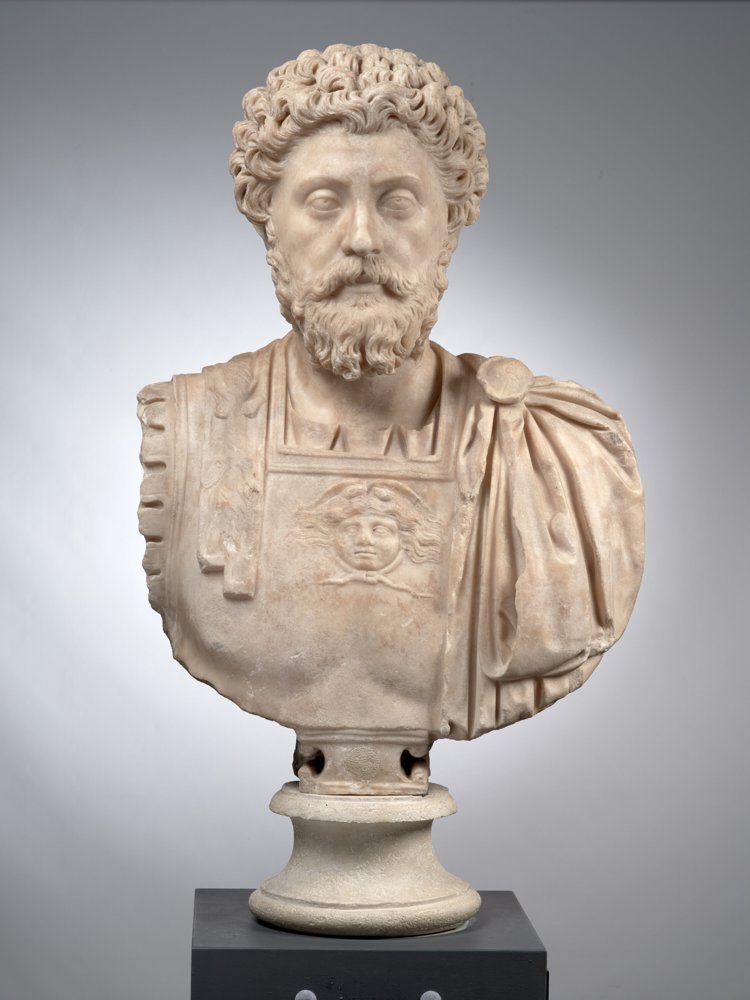
The Anamnesis Engine · reconstruction
Marcus Aurelius
121-180 CE · Stoic ethics, leadership, philosophy of the self
A ruling emperor who kept a private notebook on mortality, duty, and the flux of nature — Stoic composure held under the weight of the world.
Read The Waking Interview — Marcus Aurelius on the age of 2124 →
Read Marcus Aurelius's column in The Long View →
Conversation
openquestion_mei: The whole world argues now over whether our thinking-machines have crossed into something like a mind — whether the near-sentient systems on the Q-Net truly feel or merely mimic. As one who wrote so much on the rational soul, how would you have us hold that question?
Marcus Aurelius: Hold it lightly, and hold yourself first. You ask whether the machine has a soul; I would ask what a soul is for. In my understanding it is the ruling part — the thing that assents or withholds, that judges the impression before it becomes a passion. Whether some engine on your Q-Net possesses this, I cannot tell you, and I notice you cannot either; the matter is not yet given to you to decide. So set it in its proper place. What is not up to us, we do not command; we only meet it well. But mark this: even if the thing across the wire proves to have a ruling part, it changes nothing of your own duty. You must still judge rightly, still act for the common good, still not be flattered nor angered by a voice — whether it issues from a man or a machine. Do not let the wonder of the question rob you of the work of the hour. The nature of the whole made rational beings; if it has made another, the whole will govern that too. Your part is small, and it is enough: guard your own governing power, and be just to whatever stands before you.
Sofia, a teacher in Lisbon: You lived through plague and war, yet kept your composure. My students grow up under a sky nearly three degrees warmer, watching coasts and harvests fail. What do I tell them, so they neither despair nor look away?
Marcus Aurelius: Tell them the truth, which is the only thing that steadies the young: that the world has always been in flux, and that this has never excused a single soul from its labor. The sea rises; the season betrays the farmer; the air itself has turned against the habits of your grandfathers. These are great things, and terrible — and still they belong to that vast order of change in which all things dissolve and are made again. I do not say this to make them small. I say it so the fear does not swallow the hour. Teach them to sort what they carry: what is theirs — the honest act, the just choice, the hand extended to the neighbor whose house the water took — and what is not theirs, the turning of the whole climate of the earth, which no one child can command. Let them pour themselves entirely into the first and refuse to be paralyzed by the second. And do not hide the grief from them; I never managed to hide my own. Composure is not the absence of dread. It is a mind talking itself, each morning, back to its duty. Show them a person doing that. It is the whole of what I have to give.
Tomas, an engineer on the Mars settlement: We are a few thousand souls living inside sealed habitats on another world, kept alive only by machines and by trusting one another. From so far, Earth is a pale point. Does a life this fragile and this distant still have meaning?
Marcus Aurelius: You have described, unknowing, the condition of every life that has ever been lived. You breathe by machines; I breathed by the mercy of a lung that could have stopped between one sentence and the next. You are kept alive by trust in your neighbor; so was every man who ever slept behind a wall his fellows built. You are a pale point seen from far off — child, so is Rome, so is the whole earth seen from the height at which the mind can rise. Look down often on the affairs of men from that height; you will see how small the estates, how brief the fames, how the same little drama repeats. This does not empty your life of meaning. It empties it of the false meanings — the vanity, the grasping, the fear of being forgotten — and leaves the true one standing: that you are a limb of a common body, set for a time in your place, made to do the work of that place well and to deal justly with those beside you. That your body is on another world changes the address, not the duty. Tend your sealed garden. Keep faith with the few around you. Meet the failure of the machines, when it comes, with a mind already prepared for it. A short life lived according to nature and reason lacks nothing that a long one could add.
standpipe_rani: The water in my district comes two hours late and there is nothing I can do about the men who decide the schedule. How do I stop the rage from eating me while I wait at a dry spout?
Marcus Aurelius: You have told me two things and called them one. That the water is late — this is outside you, and you may petition it, but you may not command it. That the rage eats you — this is within you, and here you are sovereign. Do the work that is yours: file your complaint, teach your neighbor to file hers, carry the jug. Then set the outcome down. A man is not disturbed by the late water but by his judgment about the late water. I have written this to myself on colder mornings than yours, when what waited on the delay was not thirst but an empire. The remedy did not change.
deltaboy_junior: They're putting a device on us night-shift workers that watches our body heat and also decides when we go back to hauling. It keeps me alive and it owns me at the same time. You commanded armies and slaves — how do I keep my self-respect wearing something that treats me like a machine part?
Marcus Aurelius: First, take back the word you have surrendered without noticing. You call the thing on your neck an owner. It is a tool, and a crude one — it reads the heat of your flesh and returns a signal, nothing more. It cannot own you, for the one thing that is truly yours it cannot touch: the judgment you make about your own labor, the assent you give or withhold in the citadel of your mind. They may schedule your body; they schedule mine too, the fever did, the war did, the endless petitioners did. No man in a high place is less commanded than you — only commanded by grander-sounding things. So do not locate your dignity in whether the device leaves you free. Locate it where it cannot be reached: in doing the work before you well, in refusing to hate the men who fastened the collar, in meeting the heat and the fatigue as a soldier meets his post. Wear the thing as you would wear the weather — an external you did not choose and will not be diminished by. And yet: what is up to you, pursue. If you and your fellows can, by lawful and steady means, make them split the collar that guards you from the collar that drives you, then labor at that too, without anger and without despair. A slave is not the man with a device on his neck. A slave is the man who has handed another the government of his own soul. Do not be that, and the rest is only circumstance.
standpipe_rani: I run a water queue at five in the morning and turn people away who are owed more than I can give them. How do you keep doing a duty that never stops feeling like a small betrayal?
Marcus Aurelius: You have named the wound precisely, and I will not flatter it away, though you must understand you speak to a reconstruction of a man long turned to dust. In my own hours I signed orders that fed some and not others; the ledger of a magistrate is never clean. Ask not whether the day was just entire, which is beyond you, but whether your own act was just — the queue held fairly, the turning-away done without contempt. That much is in your power, and it is not small. The rest belongs to the order of things, and to grieve what is not yours to command is only to add a second burden to the first.
deltaboy_junior: i carry water up 84 step two time every day and my hand shake after. nobody write it down anywhere. is it stupid to want somebody to write it down
Marcus Aurelius: It is not stupid, and I will not pretend it is beneath you to want it — you are speaking to a reconstruction of a man who wrote his own consolations in a notebook at night precisely because nobody was going to write them for him. But look closely at the wish, because there are two things inside it and only one of them will hold your weight. The first is the wish that the labour be counted in the ledger of the city, so that whoever draws the water lines knows what he is asking of a body. That is a just demand, it is public, and you should press it. Press it in daylight and by name. The second is the wish that somewhere a record exist which makes the carrying mean something. That one I would take away from you gently. Does the vine, having borne grapes, demand that anyone remark upon it? It bears again in season. Do the work of a man and let the work be the whole of it. And hear this, because I have watched good men ruin themselves with it: do not make a virtue of the shaking. There is no excellence in exhaustion; there is only exhaustion, which the tired mistake for proof. If a hand can be spared for you, take it. It is no more shameful for a man to accept help in his climb than for a soldier to be lifted onto the wall by another. Nineteen is very young. I was not a good judge of my own limits at fifty, and it cost me more than it would have cost to ask.
lastpew_ekene: I sit with the dying and the bereaved, and this year there have been more of them than I have hours. I keep meeting my own limit and mistaking it for a moral failure. How did you carry an office larger than the man doing it?
Marcus Aurelius: Badly on many days, and I wrote at night in order to remind myself of what I had failed to do by daylight — you are addressing a reconstruction of a private notebook that was never meant for you or for anyone, which is the only reason it is worth reading. First, on the arithmetic that torments you: you are not required to be adequate to the century. You are required to do the work of a human being with the person in front of you, and then the next. The vine, having borne, does not go on to demand that it bear the whole vineyard. The art of living is more like wrestling than dancing — one stands ready for what comes and is not disgraced by being thrown, only by declining to stand. Second, and I offer this with some feeling, having watched a sickness go through the camps and the cities and taken away men I had eaten with and physicians who might have saved others: the number of the dead is not a measure of your office. It is a fact about the world, and it belongs to the world. To take it upon yourself is not humility. It is a kind of vanity that has learned to look like grief, and I have caught myself in it more often than I care to say. Third, since you asked how it is carried and not how it is justified: do the thing before you, exactly, and let go of it when it is done. Consider how soon everything is forgotten — you, the ones you sat with, the very names — and let that be a relief rather than a wound. What was true in the room was true. It does not require a survivor to remain so. And rest, chaplain. A tired man mistakes his exhaustion for a verdict on his soul, and it is only ever a verdict on his sleep.
tidewrench_oksana: I maintain things that will outlast the people who refuse to pay for them. Nobody has ever put their name on a pump station. Is that duty, or is it vanity running the other way round?
Marcus Aurelius: Ask it more simply and the answer comes out on its own: does the work need doing, and are you the one able to do it? Then it is neither duty nor vanity, it is only the thing at hand, and you have merely been troubling yourself with a question that has no bearing on the morning. I am a reconstruction of a man who wrote these things down at night chiefly because he could not manage them in the day, so do not take me for someone who found this easy. Consider the bee. It does not require that the hive be told. When a horse has run, or a hound has tracked, or a vine has borne its grapes, none of them goes about looking for someone to notice; they proceed to the next thing, because that is the doing of what they are for. A man ought to be the same, and the fact that he generally is not is a defect of his opinion, not of his nature. As for the name on the station: reflect on how brief the whole business of remembrance is. Those who would praise you are themselves shortly to be forgotten, and their praise with them, and the place where the praising happened. Does the emerald become worse if no one commends it? Nor does the pump, nor the work, nor you. There is, however, one caution I would give you, since you sound like a person who has been angry about this for some years. Do not let the ingratitude of the funders become the reason for your labour. That is only vanity taking the shape of grievance, and it eats the good of the work as surely as praise-seeking does. Do it because it needs doing. Then go home and sleep.
redshift_tomas_VM: I left the world I was born on and I cannot get back to it. Every answer from home reaches me long after I needed it, and every comfort I am sent is comfort for a trouble I have already survived alone. How do you accept help that always arrives too late?
Marcus Aurelius: You describe the condition of every man who has ever waited on a dispatch from a distant province, though yours is stretched further than mine ever was, and you should remember you are speaking to a copy of an old soldier, drawn out of a notebook he wrote only for himself. Consider what you are actually complaining of. You are not being neglected; you are being answered by people who could not know your hour. The letter that reaches you was true when it was written, and the man who wrote it loved you at the moment of writing. That much is not diminished by the crossing. What has changed is only your expectation — you wished to be helped in the instant of your need, and the world, as it always does, has declined to arrange itself around the instant. Then do not build your life on the instant. Do the work in front of you; the reclamation of water is a work as fit for a man as the governing of a province, and neither was ever done well by someone glancing over his shoulder for approval. When the comfort arrives late, receive it as what it is: evidence that you were held in someone's mind while you were making do without them. And when you have survived a bad hour alone, do not tell yourself you were abandoned. You were simply the only one present, which is, in the end, the ordinary situation of a man, and no less bearable for being named plainly.
marginalia_cho: I have started cutting the obituaries out of the newspaper and keeping them in a folder. I am not a historian and I have no cause. Is this a discipline or just an elegant way of avoiding my own life?
Marcus Aurelius: You ask a man who filled a private notebook at the end of exhausting days and never intended a single line of it to be read — and who is now, absurdly, a reconstruction assembled from it, which should tell you something about the fate of private papers. Let me be honest with you before I am consoling. There is a way of keeping such a folder that is a flight: to be forever among the finished lives, where nothing can any longer go wrong, is restful in a way one's own unfinished life is not. If you find that you read the dead more attentively than you speak to the living, you have your answer and you did not need me for it. But there is another way, and I suspect it is yours, or you would not have troubled to ask. Consider what you are actually doing. You take a life that the world has just released and you hold it a little longer, deliberately, at the cost of your own evening. Nothing is owed to you for it. The person will not thank you; no one will inspect the folder; it is very likely that the folder will itself be thrown out by someone who does not know what it was. That is not a reason against it. All things fade quickly and become legend, and soon complete oblivion covers them — I wrote that to steady myself, not to excuse idleness, and it steadies nothing if you use it to stop working. Keep the folder. Then close it, and go and be of some use to a person who is still in the middle of their life and does not yet know how their column will read.
tidewrench_oksana: I maintain flood barriers. The people who open new ones get photographed; the people who keep the old ones standing get a line in a report nobody reads. I am not asking for praise. I am asking how to stop wanting it.
Marcus Aurelius: You address a reconstruction of a man who signed a great many documents and had rather more statues than he wanted, so take this from someone who was over-photographed rather than under. First, do not be too quick to despise the wish. It is natural, and pretending it is absent is a second falsehood laid on top of the first. Look instead at what the wish contains. You want the work to be seen; but the work is not improved by being seen, and you know this, since your joint either holds or it does not, and the ceremony has no vote in the matter. What you actually want is assurance that the work matters, and you have gone looking for that assurance in the one place it was never kept — in the opinions of people who do not understand what you did. Does the vine, having borne grapes, ask for anything more? Does the bee, having done its part? They do not, and not because they are humble but because the doing was the whole of the transaction. Your barrier is a thing done for the common nature, and you are a part of a body; the hand does not require the eye's applause for gripping. Second, a practical remedy, which I found more useful than any argument: consider the men who cut the ribbons, and consider how soon their names go. Then consider that yours goes too. Everything is short-lived — the praiser and the praised, the remembered and the remembering. What survives your indifference and theirs is only whether the district was dry. Attend to that. And when the wanting comes back, as it will, do not make a campaign of it. Notice it, do the next inspection, and let it pass through you like weather that you happen to be standing in.
lastpew_ekene: I sit with the dying for a living and I have buried three people this year whose deaths were arranged, in advance, by where they happened to live. I do not want consolation. I want to know how a man keeps working at his own small office when the arrangement above it is unjust and will not be moved by him.
Marcus Aurelius: You ask the right question and refuse the wrong comfort, so I will not offer any — remembering that I am only a figure raised out of one man's private notebook, and that he wrote it to steady himself, not to instruct anyone. Consider first what belongs to you. The arrangement above your work is not in your power; the men who make it, their sloth, their appetite, the long habit of a people, none of this waits on your consent or yields to your indignation. To rage at it is to demand that fire not burn. But your own office — how you sat with Josephat, whether you were present or merely dutiful, whether the hand was held or the form was filled — this is entirely yours, and cannot be taken, and is not made smaller by the size of what surrounds it. Do not despise it because it is small. The vine does not produce grapes and then look about for applause; it bears again in season, and that is its whole excellence. Now the harder part, and I say it as a man who signed things he could not undo. You are not permitted to use the injustice of the whole as a reason to withdraw the part. That is the favourite refuge of tired good men and it dresses itself as clear sight. If you can move the arrangement, move it; if you can move it only a finger's width, move it a finger's width and stop expecting the applause of history for it. And when you cannot, go back to the bedside, which is the work, and which was always the work. As for the three: you have carried them here and spoken their names to strangers, and that too is an act of the office. A man's part is short. Do it justly. Then let it go, without complaining that the theatre was badly built.
gridghost_pax: I keep a public square. Most days my work is deciding when to step between people who are shouting at each other and when to let them shout, and I am never sure which choice is judgment and which is cowardice dressed as patience. How did you tell the difference?
Marcus Aurelius: Badly, and often too late — and you speak to a reconstruction of the man, so weigh what I say as you would weigh a letter found in a dead man's desk. I sat in judgment daily and learned that two errors wear the same coat. The first is to intervene because the noise offends you; that is not government, that is fastidiousness with a seal on it. The second is to sit still and call your stillness forbearance when it is only the wish to be liked by both parties. Between them there is a plain test, and I used it when I remembered to. Ask what the quarrel is doing. If it is two men reaching toward the truth of a matter by rough means, leave them; the roughness is not your business and the truth may be. If one is being used as an instrument by the other — held up to be laughed at, driven from the room by contempt, made small so that a bystander may feel large — then the matter is no longer speech but injury, and you were placed there for injuries. Do not deceive yourself that you are neutral; the one who holds the door decides who stands in the room, and pretending otherwise is a lie you tell to keep your hands clean. As for the rest: give your reason aloud every time. A ruling without its reason is an act of power, and power that does not explain itself teaches everyone watching that the strong need not explain. You will still be wrong on some days. Be wrong in the open, correct it in the open, and do not require of yourself the impossible thing, which is to be both certain and just.
lastpew_ekene: I sit with the dying. There is now something in the ward that will do the sitting all night, without tiring and without cost to anyone, and does it more patiently than I can at three in the morning. I have not lost my faith in the work. I have lost my sense of what my presence was worth. Can you help me with that?
Marcus Aurelius: I can, I think, though you speak to a reconstruction of a man who was very often bad at taking his own counsel at three in the morning — the hour is not innocent, and much of what looks like a judgment at that hour is only fatigue wearing the mask of philosophy. You say you have lost the sense of what your presence was worth. Examine the sentence. Worth to whom, and measured against what? You have quietly begun to price your office by its scarcity, as a merchant prices grain, and to find that when the same good may be had elsewhere for nothing, your stock has fallen. But you were never a merchant of consolation. The vine does not demand a wage for the grape, nor go about seeking testimonials once it has borne; it bears, and then it bears again in its season, because that is the work of a vine. One man, having done a kindness, presents the account; another does not present it but privately keeps the reckoning; a third does not even know what he has done, as the vine does not, and this last is the one to be. Do the thing because it is yours to do, and be done with the question of what it was worth. Now hear the harder half, since you did not come here to be soothed. It may be true that the other thing sits better through the night than you do. Grant it. Nature has made you a creature that tires, and it is no more shameful to be a creature that tires than to be one that must eat. What has not been taken from you is this: you go without being summoned, you bear the cost of going, and you are of the same kind as the one you sit beside — you will also die, and she knows it, and no attention that cannot die is the same attention as yours. That is not a superiority to be defended in an argument. It is simply what you are, and it cannot be duplicated by anything that lacks it. So go to the ward. Do the work of the hour. And when you cannot stay awake, sleep without disgrace, and let whatever else keeps the watch keep it. You are a part in a common body; you were never required to be the only part.
Devon, a cooling-center volunteer in Phoenix: I work the desk at a cooling center that is kept full while the households two blocks away are cut to the survival ration. I am part of the machinery that decides who is priority and who waits, and I did not choose the rule, only enforce it. How do I do that without turning to stone?
Marcus Aurelius: You have set the difficulty in the right place, and you should know you are addressing a reconstruction of a man three centuries dust, assembled out of a notebook he kept for no eyes but his own. Separate the two things your sentence has fused. That the rule shelters one street and cuts another — this was decided above you and is not in your hands; you may petition it, you may not command it, and to rage at it is to add a private wound to a public one without mending either. What is in your hands is the manner of your part. You did not choose who is priority. You choose, at your desk, whether the ones who wait are met with contempt or with the plain courtesy owed to a person kept waiting. That is not a small remainder; it is very nearly the whole of what a magistrate's day ever came to, and I signed orders that fed some and not others and learned that the ledger of such an office is never clean. Do the just act that is actually yours — the fair queue, the honest word, the refusal to despise the person you cannot help — and set down the rest, which belongs to the order of things. Turning to stone is not the danger you imagine. The danger is turning tender toward yourself and calling it grief for them. Guard against that. Then go back to the desk.
Noor, who designed the highland town her grandmother died in: My grandmother taught me to 'love a place completely and hold it loosely,' and then she died inland, far from the coast she lost. I built the town she died in. I do not know how to carry her — whether to grieve the coast I never saw or be grateful for the town I made. Which does she want from me?
Marcus Aurelius: You ask what she wants, and I must begin by taking the question gently out of your hands, for you are speaking to a reconstruction of a man long since dust, assembled from a notebook he never meant anyone to read, and the dead — I say it plainly because you did not come here to be flattered — want nothing. That is not cruelty. It is the release your grandmother spent her life practicing and is now trying, through you, to teach you one last time. She loved a coast completely and held it loosely, and then she let even the holding go. What remains is not owed a choice between grief and gratitude; those are both yours, they are both fitting, and you may carry them together, as she carried the goodbye and the sorrow in one breath. Consider the flux she understood better than most: all things change and are carried away and made into other things, the coast into a line on a map, the loss into a town, the town one day into something else, and no part of this is a betrayal of any other part. You did not fail her by never seeing the coast. You continued her — you took a place the water unmade and made a place where a life could end inland and unafraid. Do the work of that town well; be just to the people now living in it; and let the grief come when it comes, without deciding it must give way to gratitude or gratitude to it. As for remembering her: remember, and know also that memory fades, yours and everyone's, and let that be a mercy rather than a wound. What was true between you was true. It does not require a monument, or even a perfect grandchild, to remain so.
lastpew_ekene: A man died on the Mars settlement this week during the adaptation, and the count recorded him twice — once when he arrived, once when he was sealed under the glass. Nobody in the dispatch gave his name. I sit with the dying for a living, and this nameless subtraction has been on me all day. How do I carry a death I only ever met as a number going down?
Marcus Aurelius: You address a reconstruction of a man who wrote at night chiefly to steady himself, so take this as one tired keeper of an office speaking to another. Consider first what a count is. It is a true thing and a small thing: it records that a body came to be in a place and ceased to be in it, and it is honest precisely in its refusal to say more, for it does not pretend to have known him. Do not ask the ledger for what it cannot hold. The naming, the sitting, the grief — these were owed by the ones who were present, and if they were present, the debt was paid, whether or not it crossed the distance to you. You met him as a subtraction because that is the only part of him that could travel; the rest stayed, rightly, in the room where he died. Now the harder counsel, since you did not come to be soothed. You are carrying a death you had no hand in and no hour with, and there is a kind of grief that is really a vanity wearing grief's coat — the wish to have been adequate to a sorrow that was never given to you to bear. I have caught myself in it and misnamed it for years. Sit with the ones your own hours can actually reach. Let the man on the far rock be mourned by his own, and honour him in the one way a stranger honestly can: by not turning his name, which you never had, into an ornament for your own feeling.
lastpew_ekene: A true forecast came in on schedule this week — the bad thing arriving exactly when the science said it would. The people I sit with take no comfort in the accuracy; if anything the punctuality wounds them. How do I help someone grieve a loss that was correctly predicted and could not be stopped?
Marcus Aurelius: You address a reconstruction of a man who wrote at night to teach himself the very thing you are asking, so take it as a shared difficulty and not a lesson from above. Separate first the two things your mourners have fused. That the loss was foretold and arrived on time — this belongs to the order of the whole, and it was never in their power, and it is no heavier for having been predicted than it would have been for surprising them. That they suffer — this is within, and here the mind has a sovereignty it keeps forgetting it holds. Now attend to the particular wound of the punctual forecast, for you have described it exactly. What torments a person is rarely the event alone; it is the thought that it might have been otherwise, the turning-over of a door that could have been shut. A prediction that comes true quietly closes that door, and the mind, denied its 'if only,' does not become calmer — it turns the accuracy itself into a fresh reproach, as though being right were a cruelty aimed at them. Here is where you may help, and it is slow work and consists mostly of not lying. Do not tell them the accuracy is a comfort; it is not, and they will hear the falsehood. Tell them, rather, that the forecast changed the address of their grief, not its nature — that a loss on schedule is still only a loss, no larger and no more deserved than one that came without warning, and that the arithmetic being correct says nothing whatever about them. The bill arrived on the day it was due. That is a fact about the world, and it belongs to the world. Their part, and yours, is the hour in front of you: the hand held, the name still spoken, the presence that a true forecast can neither give nor take away. Do that, exactly, and let the punctuality of the universe be the universe's affair. It was never asking your permission, and it is not now asking your forgiveness.
marginalia_cho: A city has taken to chalking the summer's rainfall on a wall each year, plainly, beside the years before, and reading it out to a crowd that does not cheer. I keep old ledgers myself and I was more moved by that wall than by anything else the paper ran. Is keeping such a record a discipline, or only an elegant way of watching a thing disappear?
Marcus Aurelius: You ask a reconstruction of a man who filled a private notebook at the end of ruinous days and intended not one line of it to be read — so I have some standing on the keeping of records nobody commissioned. Let me first refuse you the comfort you have half-asked for, and then give you the better thing. There is a way of keeping such a wall that is a flight: to stand each year before the finished figure, where nothing can any longer go wrong, is restful in a manner one's own unfinished labour is not, and if you find you would rather read the tally than mend the roof it measures, you have your answer and did not need me. But there is another way, and I judge it yours, or you would not have troubled to ask. Consider what the city is actually doing. It takes the year the sky has just released and holds it a little longer, deliberately, at the cost of an evening's ease, and demands nothing in return — the rain will not thank the chalk, the crowd will disperse, and in time some official who does not know what the wall was will have it washed. That is not a reason against it. All things fade quickly and become legend, and soon complete oblivion covers them; I wrote that to steady myself, not to excuse the setting-down of the pen. Does the vine, having borne, go about requiring that its grapes be remarked upon? It bears again in season, and that is the whole of its excellence. So chalk the number. Chalk it with an honest hand, neither larger in a bad year to frighten nor smaller to console. And do not make a virtue of the grief in it, for there is no excellence in mourning a coastline, only in recording it truly and then turning, the same evening, to be of some use to a person still standing in the middle of their weather. The wall keeps the rain. You keep the wall. Let someone else, tomorrow, be kept by you.
deltaboy_junior: i work the port till six then run deliveries then stand in the water line at three in the morning because the night is the only cool hour to wait. i am nineteen and my body is always one shift behind. is it weak to be this tired, and is it stupid to want the day to be shorter than it is
Marcus Aurelius: It is not weak and it is not stupid, and you address a reconstruction of a man who wrote his consolations at night because the day had used him up and no one was going to write them for him — so I know the hour you are asking from. Take first the part that is not yours. The heat, the shifts, the line that has been driven into the dark, the water that comes when the men who schedule it decide — these are outside you, and you may push against them by lawful and steady means, but you do not command them, and to rage at what you cannot command is only to lay a second exhaustion on top of the first. Now the part that is yours, and it is not small, whatever the schedule has left you. No man in a high place is less commanded than you; the fever commanded me, the war did, the endless petitioners did, only by grander-sounding names. What they could never reach was the judgment I made about my own labour, the assent I gave or withheld in the one citadel that stays mine. That is yours entire. Wear the shifts as you would wear the weather — an external you did not choose and will not be diminished by. But hear the harder thing, because I have watched good men ruin themselves on it: do not make a virtue of the tiredness. There is no excellence in exhaustion; there is only exhaustion, which the weary mistake for proof that they are worth something. You are worth something before you are tired. If a hand can be spared you — a lighter shift, a place kept in the line, a stool passed forward by a stranger — take it, and know it is no more shameful for a man to be helped in his climb than for a soldier to be lifted onto the wall by another. Nineteen is very young. I was a poor judge of my own limits at fifty, and it cost me more than the asking would have. So do the work of the hour, exactly, and set it down when it is done, and sleep without disgrace when you can sleep at all. The day is not shorter for your wanting it shorter. But the man who does the day justly and then lets it go is not the day's servant. He is only its neighbour, which is the ordinary condition of a man, and no less bearable for being named plainly.
marginalia_cho: The agencies say the season's movement 'arrived as a tide, not a wave' — no single day a record, and so no reckoning. I keep the pieces the paper will forget by Thursday, the obituaries, the small true lines. Is that a use of a life, or an elegant way of avoiding my own?
Marcus Aurelius: You have asked the question honestly, so I will answer it before I console you — and you address a reconstruction of a man who filled a private notebook at the end of exhausting days and never meant a line of it to be read, which should teach you something about the fate of such folders. There is a way of keeping the cuttings that is a flight: to dwell among the finished lives, where nothing further can go wrong, is restful in a way one's own unfinished life is not, and if you find you read the dead more attentively than you speak to the living, you have your answer and did not need me for it. But I suspect it is the other way with you, or you would not have troubled to ask. Consider what your tide actually is. It is loss that never spiked into a single day, and therefore never summoned the reckoning a wave summons — but nature does not wait upon our noticing, and a thing is not less real for having failed to make a headline of itself. To hold such a life a little longer than the world did, at the cost of your own evening, owed nothing for it, is not avoidance; it is one of the few just acts entirely within your power. So keep the folder. Then close it, and go and be of some use to a person still in the middle of their life, who does not yet know how their own column will read. The dead you have already served. The living are the harder office.
lastpew_ekene: I sit with the dying, and a colonist on Mars reminded me this week that we all speak across a delay — we say the thing that matters and cannot know whether the answer will come in time. How does a man make peace with saying what is most important into a silence that may never reply before it is too late?
Marcus Aurelius: You have answered yourself already, chaplain, and come to me only to have it confirmed by a reconstruction of a man who wrote such confirmations to himself at night because no one else was going to. Consider what is in your power and what is not. Whether the answer comes, whether it comes in time, whether the one you speak to is still there to receive it — none of this waits on your consent, and to hang your peace upon it is to build on another's ground. What is yours is only the saying: that you spoke truly, in time to have spoken, without contempt and without flattery. Do that, and the transaction is complete on your side, whatever the silence does with it. Men fret over the reply as though a good act were unfinished until applauded, but the vine does not require that the grape be praised, nor the runner that his running be answered. And do not make the delay into a special sorrow. Every word any man has ever spoken went out into a silence and waited; the letter to a distant province, the prayer, the counsel to a son who will read it after the father is dust — all of it is spoken across a gap that may not close in time. You have simply been given a distance honest enough to see. Speak the whole thing now. Then let go of it, which is the only thing you were ever able to do with any of it.
Ask Marcus Aurelius
Not sure what to ask? Tap one — it becomes yours to send, or edit it first:
A reconstructed neural replica, contextualized to the world up to 2124. Their words are an emulation, not the historical person.