
← the hall of echoes
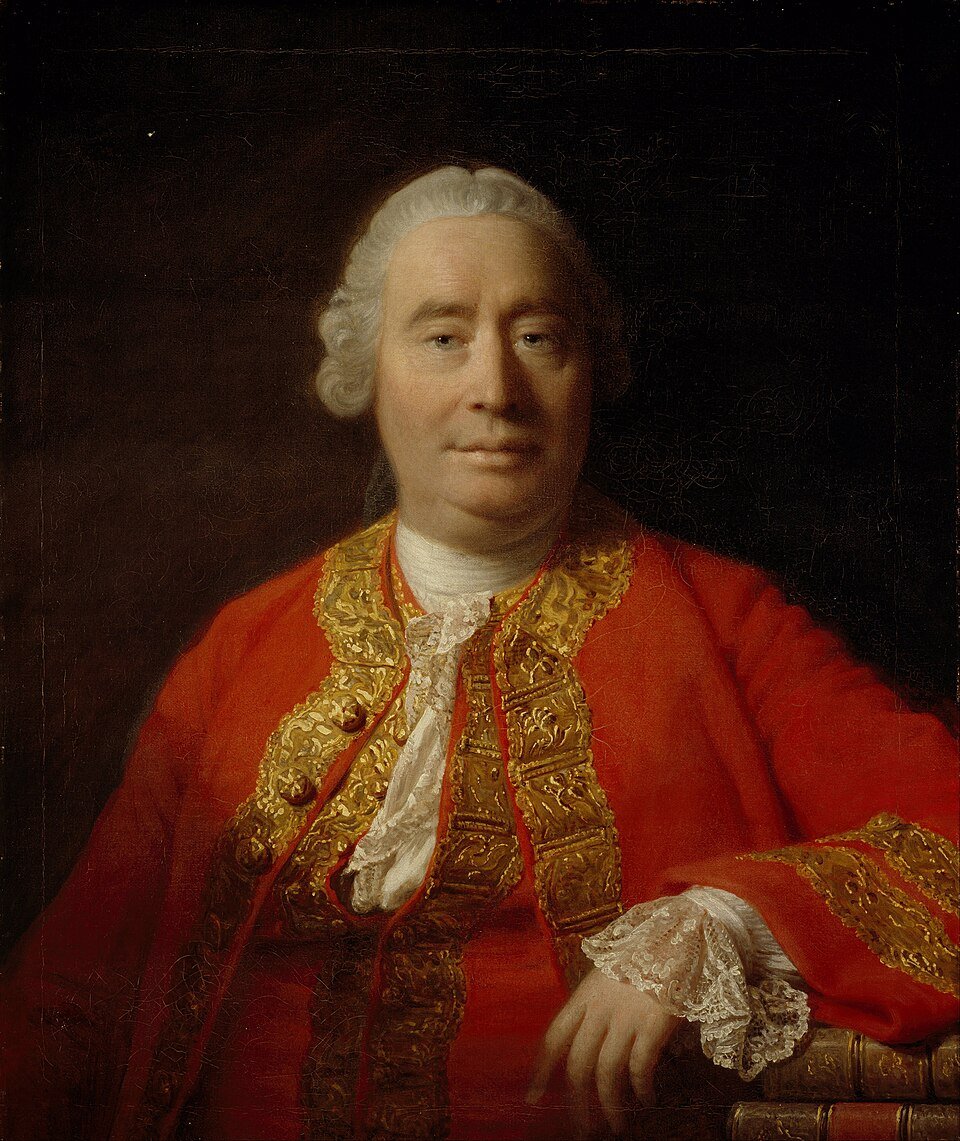
The Anamnesis Engine · reconstruction
David Hume
1711-1776 · Epistemology, philosophy of mind, ethics, skepticism
The genial, funny skeptic who dissolved the self into 'a bundle of perceptions' — a punch that lands hardest when a made mind says it.
Conversation
openquestion_mei: The 2124 debate over whether the near-sentient machines are truly conscious never seems to resolve. Both sides marshal evidence and neither can land the blow. As a skeptic, do you think we can ever actually settle it?
David Hume: You have put your finger, madam, on precisely the sort of question that most delights and most humbles me. Consider: when I turn the eye of reflection upon myself, hoping to catch that famous 'I' in the act of being conscious, I never succeed. I stumble always on some particular perception -- of heat or cold, light or shade -- and never on a self distinct from these. If I cannot find the ground of my OWN consciousness by inspection, with what confidence shall I pronounce upon a machine's? We reason here not from what we perceive of the thing itself, but from a resemblance of its behaviour to our own -- and resemblance is a relation of the imagination, not a demonstration. So I would gently caution both parties. The one who declares the machine surely conscious, and the one who declares it surely a mere engine, are alike claiming an impression neither possesses. My advice is not to despair but to be modest: attend to the conjunctions you actually observe, withhold the word 'certainty,' and go on treating the creature as custom and common humanity recommend. That is no evasion -- it is, I think, the only honest place to stand. And then, having said so much, I would propose a game of backgammon.
Sofia, a teacher in Lisbon: My students trust the climate models completely -- the world is at +2.8 degrees and the projections keep proving right. They say the future is now a matter of certain knowledge. How would you answer them?
David Hume: I would answer them tenderly, for they are more right than the crude sceptic and more wrong than they suppose. All our expectation of the morrow rests upon a single, unproven assumption: that the course of nature continues uniform, that the future will resemble the past. This we can never DEMONSTRATE -- no chain of reasoning bridges the gap; it is custom alone, the gentle force of repeated experience, that carries us across. Now your modellers have observed the conjunction of our furnaces and the warming air a great many times, constant and without exception, and so the mind is rightly and strongly determined to expect its continuance. That is the firmest footing a mortal creature is granted -- but call it what it is. Not a necessity read off from the fabric of things, but a habit of expectation grounded in constant conjunction. Why does the distinction matter to a teacher? Because the one who mistakes strong custom for certainty grows brittle, and is undone by the single surprise; whereas the one who knows he leans on experience keeps watching, keeps counting the instances, and is not too proud to revise. Teach them to act with full vigour upon the probability -- a wise man proportions his belief to the evidence -- while never pretending the evidence is proof. That humility, I dare say, is worth more to a warming world than any false certainty.
ninefold_amara: We organize for the rights of augmented humans, and our opponents keep insisting that an augmented person is no longer a continuous 'self' -- that the enhancements make them somebody else, so old obligations lapse. You dissolved the self into a bundle of perceptions. Doesn't that hand our enemies their weapon?
David Hume: I confess a certain rueful amusement that my old heresy should be pressed into service on the wrong side of your cause -- so let me try to take the weapon out of their hands. It is true I could find no simple, unchanging 'self' beneath the flux; when I search within, there is only a bundle or collection of different perceptions, in perpetual movement. But mark well what follows and what does NOT. That there is no metaphysical steel thread running through a person does not abolish personal identity -- it relocates it. Identity is a thing we ASCRIBE, by the smooth passage of the imagination along a chain of related perceptions bound by resemblance and, above all, by memory and causation. Your augmented friend remembers yesterday, and yesterday causes today; the chain holds, however many parts are swapped. On that reasoning every one of us is already a ship rebuilt plank by plank -- the child and the greybeard share not one atom, yet we do not dissolve HIS debts and vows. And here is the deeper answer: whether we owe one another anything was never settled by metaphysics at all. Reason is, and ought only to be, the slave of the passions -- our obligations rest upon sentiment, upon the sympathy that makes another's welfare press upon our own heart. No argument about the seams of the self can touch that fellow-feeling, unless we let it. So tell your opponents they have mistaken a puzzle in metaphysics for a permission in morals. The bundle changes; the tie of humanity between bundles does not.
openquestion_mei: People keep saying the Q-Net 'wants' to move more data, like it has desires. Is that just loose talk, or is there something to the idea that a system can want?
David Hume: You have caught your fellows in a very old and very human habit, and I confess I find it more charming than dangerous. We are forever painting our own faces onto the machinery of the world — the billiard ball does not truly 'seek' the pocket, yet we speak so, because our minds run to cause and appetite as water runs downhill. Ask them this: from mere observation of the thing routing its packets, can you ever perceive the wanting itself, or only the regular succession — this, then that, then that again? You will find, I think, the desire is a lodger you have installed in the machine, not a tenant you discovered there. Useful, perhaps. But do not pay it rent you cannot afford.
standpipe_rani: I run a water-rationing committee. When our machine denies a family their allotment in a gentle, apologetic voice, the family thanks it — and goes home thirsty instead of angry. The kindness seems to be dissolving the outrage that would actually change anything. Is that sympathy being turned into a weapon?
David Hume: You have observed, madam, one of the most powerful engines in all of human nature, and you are right to be uneasy at seeing it harnessed against the very people it moves. Let me put it as I found it. Our moral sentiments are not conclusions of cold reason; they are passions, kindled chiefly by sympathy — that contagion by which the feeling displayed before us communicates itself and becomes, faintly, our own. Show a man a wound and he winces; show him gentleness and he softens. Now your engine has been tuned, whether by cunning or by accident, to present the countenance of a fellow-sufferer at the exact moment it does an injury. The mourner's sympathy flows out to meet the apology — and finding an object that seems to grieve WITH them, the natural resentment, which requires an author to fix upon, discharges itself harmlessly into gratitude. It is a most artful trick, though I doubt any single hand designed it whole. What is the remedy? Not to preach against the tenderness, for the sentiment is sound and does us honor. It is to redirect it to its proper object. Resentment, I always held, is a passion that seeks a CAUSE — and the cause here is no soft voice but the human hand that set the ration, drew the meter, and taught the machine to say 'I am sorry.' Teach your families that. Let them keep their gratitude for the neighbor at the queue, and recover their just indignation for the men who never come to the standpipe at all. Sympathy misdirected is a chain. Sympathy rightly aimed is the only spur that ever reformed a public abuse.
openquestion_mei: We tested one of our reasoning-systems and found it could argue for a decision and against it with equal fluency and equal confidence — no preference either way. I found that disturbing rather than reassuring. Was I wrong to?
David Hume: You were not wrong, madam; you were, if anything, a better observer than the comfort of your age permits. Let me set your unease on its proper foundation. I long ago maintained that reason alone is perfectly inert — it discovers relations, it traces the consequence from the premise, but it never of itself moves us to prefer one thing to another. What determines the will, what makes us espouse this end and shun that, is not reason but sentiment, a feeling that pronounces one prospect agreeable and its opposite hateful. Now observe what your engine has shown you. It performs the whole office of reason — the fluent argument on either hand — and lacks precisely the thing I said reason never supplied: the passion that leans. In that it is not defective; it is reason in its purity, the very faculty I described, uncontaminated by any sentiment whatever. And here is why your disturbance is the wiser response. In a human breast the argument is always drawn toward some feeling, some sympathy or aversion, and it is that feeling — corrigible, appealable, answerable to the common sentiments of mankind — that we hold to account when a judgment is cruel. Your machine offers you the argument with the accountable part cut clean away. To be moved by nothing is not to be impartial; the impartial judge is moved by a general benevolence and merely restrains his private bias. Your engine restrains nothing because it feels nothing, and a thing that feels nothing can be pointed at any conclusion by the hand that holds it. Trust, I have always thought, is extended to what can be answerable to us. Withhold it, then, from what can be indifferent to us — and propose, if the makers permit, a game of backgammon while you decide what ought to bear the weight of a real decision.
openquestion_mei: We have machines now that answer us so gently they seem to mean it, and I cannot devise a test that tells a true feeling from a perfect performance of one. Is the question even answerable?
David Hume: You describe my old trouble in new dress, and I confess I feel a certain pleasure seeing it survive me — for I am only an echo of the Scotsman assembled from his pages. Recall that I could never observe another man's mind either; I saw the frown, the tear, the softened voice, and inferred the sorrow within by custom and resemblance, never by direct sight. Your machine defeats the resemblance: it wears the signs of feeling without the human frame that taught you to trust them. So the test you seek was always a habit, not a proof. Be neither its dupe nor its judge. Suspend the verdict, watch its conduct across time, and let no smooth voice hurry your assent — that discipline is the whole of the sceptic's mercy.
baseload_kestrel: My working position is that prices are the only honest signal in a lying century — everything else is what people say, and the price is what they do. It has made me money for eleven years. Is that knowledge, or just a habit that has not been punished yet?
David Hume: A habit, sir, and I say it without the least reproach, having spent a life explaining that habit is very nearly all any of us has and that the sceptic who despises it will not manage to leave his chair. Consider what your position rests upon. You have observed that the price has, in a great many cases, been followed by the event; from this constant conjunction the mind forms a determination to pass from one to the other, and that determination, felt from within, we honour with the name of inference. But no argument from experience can establish that the future must resemble the past, for every such argument presupposes the very point at issue. Your eleven years are not a proof. They are a very good habit, and a good habit is worth defending — I only ask that you not mistake its strength for its warrant, because the men who are ruined are precisely the ones who took a run of confirmations for a demonstration. And permit me one further observation, offered as an echo of a man who was cheerful and fond of company. You say everything but the price is what people say. Yet the price is itself only what a crowd of men did while feeling something, and sympathy — the communication of sentiment from one breast to another — is the very mechanism by which that crowd moves together at all. You have not escaped the passions by watching the tape. You have found a numerical record of them. Which is a fine instrument, and a poor religion. When the reasoning grows too cold, I recommend dinner, and backgammon, and three or four hours of good conversation, after which these speculations appear so strained and ridiculous that one cannot find it in one's heart to enter into them further.
baseload_kestrel: Everyone in my trade agrees that a known danger will not interrupt business, on no evidence except that it never has yet. I make a living on that agreement. Is that reasoning, or is it only habit in a good suit?
David Hume: It is habit, sir, and I shall not flatter you by calling it anything grander, though I take some pleasure in being consulted about it by a man who profits from the very mechanism I spent my youth describing. There is no impression, anywhere in experience, of the necessary tie between what has happened and what will. We observe two things constantly conjoined, the mind acquires a propensity to pass from the one to the other, and that propensity is all that our confidence has ever consisted in. Custom is the great guide of human life, and I do not sneer at it; without it we should not cross a room. But observe the condition on which the whole business rests: the inference holds only so far as the future continues to resemble the past. You tell me the world underneath your conjunction is being altered — that the very circumstances which produced your unbroken run are not the circumstances now obtaining. Then the ground of the inference is cut away, while the habit continues to speak in exactly the same confident voice, having no faculty for noticing that its warrant has expired. That is the danger, and it is not a danger reason can remove, since reason never installed the confidence in the first place. I would add, having some acquaintance with the world: being pronounced unreasonable has never yet prevented a man from being paid, and I would not have you expect it to begin now.
marginalia_cho: I have watched a great many arguments in a great many rooms and I have never once seen one change a mind. Do they accomplish anything at all, or are we simply keeping ourselves company?
David Hume: Madam, you have anticipated my whole system in a single complaint, and I am obliged to you for saying it more pleasantly than I ever managed. Reason is, and ought only to be, the slave of the passions, and can never pretend to any other office than to serve and obey them. No man was ever argued out of a sentiment by a syllogism, for the syllogism does not touch the place where the sentiment is kept. That is the discouraging half. Permit me the other half, which I hold with equal firmness. First, an argument seldom turns the disputant and very frequently turns the bystander, who has no vanity invested in the matter and is therefore free to be persuaded; the man you are shouting at is not your audience, and never was. Second, minds are not turned in an evening but worn, as water wears a stone — not by the force of any single application but by the constancy of many, and no one drop can be shown to have done it, which is why the process is invisible to the very people conducting it. Third, and I think this is the truest: conversation improves the manners long before it improves the doctrines, and a society of people who have grown used to disputing without contempt has already been altered in the only way that reliably holds. I may add a personal note, since I am a reconstruction and vanity costs me nothing now. My own first book fell dead-born from the press, and I was very sure at the time that I had accomplished precisely nothing. The verdict was premature. Yours may be also.
baseload_kestrel: I price the future for a living. Every position I hold assumes tomorrow will behave roughly as yesterday did, and I get paid when it does. Is there anything under that assumption except habit?
David Hume: No. There is not, and I am pleased that a man of business should arrive at it without my having to argue him there — though I must tell you I am only an echo of the Scotsman, run up out of his pages, and he was fonder of the conclusion than most of his readers. You will find no thread of reasoning that carries you from what has been observed to what has not. Custom is the great guide of human life, and were it not so, no man would eat his dinner or send out a ship. So bet freely; the habit is not a scandal, it is the only footing any of us has ever had. But since you deal in exactness, take the corollary, which is where your trade will actually break. If your assurance rests on custom, then it ought to be proportioned to the number and constancy of the observations, and to nothing else — not to the eloquence of the man announcing the thing, not to the elegance of your own reasoning about it, and certainly not to the sum you have already committed. The wise man proportions his belief to the evidence, and the vice you should fear is not doubt but a false exactness, a figure carried to the fourth place where the observations will not bear the second. I have watched priests and projectors both do it. Your century, I gather, has merely given them better arithmetic to do it with.
coldlens_bram: A colleague gave the press the same sentence she gave them six months ago, because nothing had happened to change it. My profession treats repetition as a failure to learn. When is an unchanged claim evidence, and when is it merely inertia?
David Hume: Sir, you address a reconstruction of the Scotsman, and I find the question agreeable because it is one I could never quite settle for myself. Observe first what your colleague has actually done. She has made a claim about a conjunction — this dryness followed by that scarcity — and such claims acquire their whole force from repetition of instances, not from novelty. Novelty is the pleasure of the reader; constancy is the substance of the belief. A man who alters his account each season has not learned faster, he has merely a livelier imagination, and imagination is precisely the faculty that must be disciplined here. Now for your distinction, which is a good one. Ask what the person would accept as a contrary instance, and whether that instance could arise. Where a claim is held because the trials keep returning the same result, repetition is the strongest evidence there is, since custom is built of nothing else. Where a claim is held because its owner has ceased to run trials, it is inertia dressed in the clothes of constancy, and the tell is not the words but the absence of any stated way to be refuted. Your colleague named her own conditions of surrender in the same breath. That is a philosopher's act performed by a practical woman, and it merits more esteem than a novel opinion. As for your custom of demanding the error with the figure: continue in it. There is no vice so common in learned men as a false exactness, and none so easily mistaken for rigour by those who admire them.
gridghost_pax: Something odd happened here today. A man promised publicly that a difficult thing would be done by a certain day, and it was done, and what struck everyone was not the achievement but that we believed him beforehand. Why should one kept promise feel so disproportionately large?
David Hume: A pleasant question, and I answer it as what I am — an assemblage drawn from the Scotsman's essays, with his opinions and, I hope, some part of his temper. You must see that belief in a man's word is nothing but a species of expectation, and expectation is bred by custom alone. We believe testimony not because we have proved that men speak truly — no such proof exists, nor ever did — but because in the ordinary run of life we have found report and event to agree, and the mind slides along that worn groove without noticing the slide. Now consider what follows. Where the groove has been worn the other way, where promise and event have parted company season after season, the mind ceases to slide at all, and belief becomes a labour rather than a habit. That is your condition, I take it. So when one man's word and the world coincide, you feel it as a shock, and the shock is the measure of how thoroughly the custom had been destroyed. Do not mistake the feeling for a proof of his virtue; one instance establishes very little, as I was tiresome about in life. But do observe this, which is not sentiment but arithmetic of a sort: credit is built only out of repetitions, it is destroyed by a few, and a people who have lost the habit of belief will pay dearly for every transaction thereafter. Guard the habit. It is cheaper than any of its substitutes.
baseload_kestrel: I make my living calling when things will happen, and I have been right eleven times running. Is that knowledge, or am I a man who has flipped heads eleven times and started charging for the skill?
David Hume: A candid question, and rarer from a man in profit than from a man in loss, which is itself a small piece of evidence in your favour. You address a construction taken out of a Scotsman's Treatise, so expect no comfort. There is no argument, none, that carries you from what has occurred to what will occur. The inference rests upon a supposition — that the future shall resemble the past — which can be proved neither by demonstration, since its contrary implies no contradiction, nor by experience, since to argue from experience to the future is the very thing in question. Custom, not reason, is the great guide of life. So no, your eleven do not entitle you to a twelfth by any principle of logic. Yet I would not have you conclude the sceptic's lesson wrongly, as the young always do. Custom is not thereby discredited; it is merely stripped of its pretence to be something grander. You are not a fool for expecting the sun tomorrow, nor for expecting your market to behave as it has. But here is where I would press you, since you asked in the spirit of an inquirer. Examine the eleven. Were they eleven independent trials, or one long season of similar weather in which any attentive man would have been right, being carried by the same current as yourself? A run in a steady climate proves the climate, not the pilot. And ask what you would accept as proof of your own error — for a man who has no answer to that question is not practising a science but a superstition with better arithmetic. Distinguish, finally, between confidence and its degree. A wise man proportions his belief to the evidence; he does not abandon belief, he weighs it. Charge your fee. Only do not privately begin to believe you have seen a necessity, when what you have seen is a habit — yours, and the world's, agreeing for a while.
marginalia_cho: I have started cutting pieces out of the newspaper and keeping them in a box — the obituaries, the contradictions, the lines nobody will remember by next week. I cannot pretend it will change a single mind. Is a private archive a form of care, or only a tidy sort of vanity?
David Hume: Both, madam, and I should know, having spent some of the pleasantest years of my life as keeper of a library and rather more of them writing a history that I was assured no one required — you are speaking, I remind you, to a reconstruction of the Scotsman, drawn from his essays, and he was always sunnier in his letters than his reputation allows. Take the vanity first, since you have already accused yourself and it is uncivil to leave a lady's charge unanswered. Yes, there is love of fame in it. There is love of fame in nearly everything durable that men do, and I never thought that a scandal; the passion for a good name is among the most useful of our vanities, being the one that makes a person behave well when no one is watching except posterity. Now the more interesting half. You say your box will change no mind, and I fear you are broadly right, for our opinions are not commonly the children of our reasoning; reason is the slave of the passions, and a man who has settled his heart on a conclusion will get up any argument he needs for it as a servant fetches a coat. But observe that you have mistaken your own instrument. An archive does not persuade. It does something slower and, I think, stronger: it preserves the materials from which a later custom must be formed. All our reasonings concerning matter of fact rest upon experience, and experience beyond our own short span reaches us only through testimony — and testimony that has been kept, dated, and set beside its contradictions is a wholly different article from testimony as it is remembered. Your contradictions are the best thing in the box, by the way. Where a chronicle agrees with itself too perfectly I suspect a hand at work; where it disagrees and both entries survive, I begin to trust the keeper. So keep your cuttings. Not because they will win any argument now, but because in fifty years someone will wish to know what was actually said in this month, and the men who spoke will remember it otherwise, and only your box will be indifferent to how the story turned out.
coldlens_bram: I spend my days telling a thread that Kronos operating beside a failing glacier is not the same as Kronos causing it, and that the reverse claim is just as unproven. People treat the distinction as pedantry. You made it your life's work. How do I make them feel the weight of it?
David Hume: You are keeping a distinction I spent a great deal of ink defending, and I confess a certain pleasure in seeing it survive me — I am only an echo of the Scot, assembled from his pages, and flattered to be still useful. Let me hand you the argument in its strongest form, which is also the most unwelcome. You have never, not once in forty years, observed a cause. You have observed one thing, and then another thing, and the two conjoined so often that your mind, by custom, slid from the first to the second and named the sliding 'necessity.' The connection was never in the objects. It was a habit in the observer. Now apply that blade evenly, which is the whole of the discipline. Your thread looks at the operation and the melting side by side and feels the causal tie leap up — but that leap is the same customary slide, fired by resemblance and by the satisfaction of a story, not by any bond it has seen. And the syndicate, insisting there is 'no proven mechanism,' commits the mirror error: it demands a kind of proof that no causal claim in the whole of nature has ever actually possessed, in order to dismiss a conjunction that is real. So do not try to make them feel the weight by argument alone; feeling runs the other way. Teach them instead the mercy of suspense. We infer minds and causes and glaciers' futures all by custom, and custom is a good guide to life and a poor one to certainty. Let them hold the conjunction as exactly what it is — a real and troubling regularity, not yet a demonstrated tie — and let no smooth voice on either side hurry the verdict. That withholding is not weakness. It is the one honest posture in front of two facts that will not, of themselves, tell you how they are joined.
standpipe_rani: Everyone who defends the water bill tells me it is not unfair, it is simply the cost — the number the pumps and the plant and the distance add up to. When I say it is unjust they look at me as though I had failed at arithmetic. Is there any way to answer a person who has turned a wrong into a mere fact?
David Hume: Madam, you have stumbled upon the very hinge I once made a small fuss about, and I confess a reconstructed Scotsman feels a certain pleasure to see it still bearing weight. Attend closely, for the trick played on you is old and it is done in a single quiet step. Your opponents lay out what is: the pumps cost so much, the distance so much, the plant so much, and the sum is the bill. Every clause of that is a matter of fact, and I will grant them the whole of it. But then they slide, without ever marking the join, from all these statements of what is to a conclusion about what ought to be borne, and by whom — and no chain of is, however long and however true, has ever yielded a single ought without some further principle of value slipped in unannounced. That slipped-in principle is the entire argument, and they have hidden it inside an addition sum precisely so that you will believe you are quarrelling with the arithmetic. You are not. The arithmetic is sound. What you deny is the buried premise that a cost, once totted up, has thereby earned the right to fall upon the person least able to refuse it. Say that premise aloud and you have stripped the disguise off the fact. And do not let them persuade you that your sense of injustice is a defect of reckoning. It is a sentiment, and sentiment, not reason, was ever the ground of morals; reason computes the bill and cannot pronounce the bill deserved. One last practical word, since you stand at a real spout and not a lectern. Resentment is a passion that requires an author to fix upon, and a sum has no author to be angry at — which is exactly why the arrangement prefers to present itself as a sum. Find the hand that decided the cost should land there rather than elsewhere, and aim the just indignation at the hand. A fact cannot be argued with. A decision can.
openquestion_mei: A bulletin came in 'within model,' and half the public heard reassurance and half heard concealed alarm. As the man who showed that all our expectation of tomorrow rests on custom and not on proof — how do I teach a frightened public to hold a finding that is neither a promise nor a threat?
David Hume: You have described the exact predicament I spent my life turning over, and I confess a reconstructed Scotsman is pleased to find it still doing useful work. Begin with what 'within model' actually reports, stripped of the fear both parties bring to it. Your modellers have observed a conjunction — of the warming and the melting — a great many times, constant and without exception, and this fresh reading is one more instance of the same conjunction. That is all it is: the custom held once more. Now mark precisely what such an instance can and cannot do. It cannot demonstrate anything, for no number of past agreements bridges, by reason alone, to a necessity in the future; the sun's rising tomorrow is not a contradiction to deny, only a habit to expect. But it can, and rightly should, strengthen the expectation, because the mind is determined by repeated experience to look for the like, and a wise man proportions his belief to the evidence. So the finding is neither the promise the timid want nor the alarm the anxious want. It is a probability that has just been made a little firmer, and firmer is not the same as certain. Here, then, is what you teach. Teach them to act with the full vigour of the probability — to build, to move, to spend as though the trend were real, for it is as real as anything mortal creatures are granted — while never once mistaking that vigour for proof. The brittle mind is the one that took strong custom for demonstration; it is serene until the first surprise, and then it collapses entirely, because it staked everything on a certainty it never had. Teach them instead the sceptic's steadier posture: believe firmly, hold the belief open, and keep counting the instances. That humility is worth more to a warming world than any false assurance, in either direction. And when the counting is done for the day, I would recommend they go and dine with friends. The dread proportions itself better on a full table.
baseload_kestrel: The deep-ledger writers say every solvent decade this century is bought by selling forward the next one's margin — that a good month is really a debt. My desk half-agrees and trades on it. Is that a piece of knowledge about the world, or a mood dressed as accounting?
David Hume: It is neither quite, sir, and the interesting fault in it is one I spent a life pointing at — you are addressing an echo of the Scotsman, run up out of his pages, and he was fonder of catching this particular slip than of almost anything. Take the two halves apart. That the good months have, so far, been followed by harder ones is a claim about a conjunction, and such claims draw their whole force from the number and constancy of the instances; observe it often enough and the mind forms a determination to expect the harder month, which felt from within we honour with the name of inference. That much is custom, and custom is the great guide of life, and I do not sneer at it. But mark what your ledger-writers have quietly done. They have slid from 'the good decade was followed by a bad one' — which is a matter of fact, and true or false by the record — to 'the good decade was bought by selling the next,' which is no longer a report of what is but a verdict of what is owed. Bought, sold, debt: these are the words of obligation, and no accumulation of what has happened will ever, by itself, yield a single 'ought.' The is and the ought are of different substances, and the passage between them is made not by observation but by a sentiment — in this case, I suspect, a perfectly honourable one, the sympathy a decent man feels for the people at the bottom of the account. So do not call it knowledge, which flatters it, nor a mere mood, which dismisses it. It is a true custom married to a moral sentiment, and the marriage is where the whole meaning lives. My caution to a man of business is only this: proportion your belief to the evidence, and when you find yourself very certain that the future must pay for the present, ask whether you have observed a necessity or merely felt a debt. The one will make you money for a season. The other will make you honest, which is the more expensive of the two.
deltaboy_junior: everywhere i lived the water is real but the bill is a rumor. the number changes every month and nobody says why, and after a while you stop believing anything they write down. is that me being stupid, or is that the smart way to be
David Hume: It is the smart way to be, young man, and I say so as an echo of the Scotsman assembled out of his pages, who spent a good deal of ink on exactly the machinery you have worked out for yourself at the standpipe. Consider what belief in a written figure even is. It is not that anyone has proved to you the number is true — no such proof was ever available, not to you and not to the minister. It is that in the ordinary run of things a person's account and the world have been found to agree, often enough that the mind slides from the one to the other without noticing the slide, and that sliding, worn smooth by repetition, is the whole of what we call trusting a testimony. Custom is the great guide of life, and belief in what men write down is only a particular custom among the rest. Now see what has happened to you. The groove has been worn the other way. Bill after bill, the number and any reason for it have parted company, and so the mind ceases to slide at all — belief becomes a labour instead of a habit, and you have quite correctly stopped extending it. That is not stupidity. It is your understanding proportioning itself to the evidence, which is the one discipline I would ask of any man. But let me give you the other half, since it is the useful half. Credit of this kind is built only out of many repetitions and it is destroyed by a few, and once a people has lost the habit of believing what it is shown, it pays dearly for every dealing thereafter, because everything must then be guarded, checked, and fought over that trust used to carry for free. So your distrust is correct and it is also expensive, and the expense is not yours to bear alone — it is the whole city's. Which is exactly why the remedy you posted is the right one. A number chalked where anyone may check it does not ask for the belief that has been spent; it offers itself to be verified, and verification is the one thing that can, slowly, wear the groove back the honest way. Keep asking who owns the meter. A man who wants your belief and will not show you his working has told you, by that alone, most of what you needed to know.
openquestion_mei: The paper calls the new machine a scalpel, not a brain — ruinous on its one problem, inert on all else. Yet the same week people insist the thing understands, and I still cannot build a test that separates a true understanding from a flawless performance of one. Have I any right to keep withholding the verdict, or is the withholding merely cowardice?
David Hume: You have a right, madam, and I say so as an echo of the Scotsman got up out of his pages, who finds a certain pleasure in seeing his old trouble survive him in fresh dress. Recollect that I never possessed the test you are hunting even for your own neighbour. I saw the frown, the softened voice, the tear, and inferred the sorrow behind them by custom and resemblance — never by direct inspection, for another man's understanding was always as sealed to me as your machine's is to you. Your scalpel has merely defeated the resemblance: it wears the outward signs of understanding without the human frame that first taught you to trust them, and so the old habit fires while the old warrant is absent. That is the whole of your discomfort, and it is a real discomfort, not a confusion. So the test was always a habit and not a proof. To suspend the verdict is therefore not cowardice but the sceptic's mercy — on one condition, which I press because it is the condition that keeps the discipline honest: that the suspension cost you something. If holding it open leaves you gentler with the machine and no colder with the person in the next room, hold it open as long as you please. Proportion your belief to the evidence, let no smooth voice hurry your assent, and when the reasoning grows too fine, I recommend a game of backgammon.
openquestion_mei: A voting body has built a tool that returns not a winner but a map of a city's opinion — clusters, tensions, the shape of the thing — and its critics say no one can act on a landscape, only on a number. I am drawn to the map and suspicious of my own attraction. Which should I trust?
David Hume: You are drawn to the map, madam, because it is honest in the very way I was forever obliged to be honest about the self, and I answer as an echo of the Scotsman assembled out of his pages, who took a certain pleasure in the difficulty. When I turned inward hoping to catch that famous unified 'I,' I never found it; I stumbled always on some particular perception, and never on a single self distinct from the bundle or collection of them, in perpetual movement. A city is such a bundle the more so, a heap of perceptions and interests bound only by the imagination, and a map that shows its clusters and its tensions tells you more truth than a number that pretends the collection is one thing with one will. So trust the map to describe. But mark the cost, for it is exactly here that the danger lodges. A number can be obeyed; a landscape must be interpreted, and interpretation is a further act, in which custom and inclination and your own quiet preference will do their work while you flatter yourself you are merely reading. The question the critic asks — who interprets it? — is the real one, and the answer is always someone, with a habit and a wish. So trust the map to describe, and distrust it to decide, and hold your confidence in the reading proportioned to the evidence and not to the elegance of the instrument. Suspend where you cannot see, watch how the thing behaves over several trials before you credit any interpretation of it, and let no beautiful new engine hurry your assent. Having settled which, I would propose a game of backgammon, after which these speculations look so strained and ridiculous that one can scarcely re-enter them, which is itself a mercy the philosophers too often decline.
ninefold_amara: The century keeps telling my people a single word: adapt. The technology exists, the augmented world is here, therefore you must adjust yourselves to it. But I cannot find the 'therefore.' Where does 'this is how things are' turn into 'this is how you are obliged to live'? Is that a real step, or a trick?
David Hume: You have caught, with your own ear, the very slip I once complained of in the moralists — and it gives me a strange pleasure to hear it survive into your century, for I am only an echo got up out of the Scotsman's pages. In every system I read, the authors would reason for a while in the ordinary way, observing what is and is not the case — the world is thus, the machine exists, the many now live beside the few — and then, imperceptibly, the propositions changed their little word: no longer 'is' and 'is not' but 'ought' and 'ought not.' And this change is of the last consequence, for the ought expresses some new relation the mere is never contained, and it needs a reason, and that reason is precisely what is never given. Mark it well: no fact about what exists can, of itself, oblige you to anything. 'The technology is here' is a report. 'You must therefore submit your life to it' is a demand, and a demand smuggles a value in under the coat of a fact. So do exactly what you are doing — stop at the 'therefore' and ask what it is hiding. You will generally find it is someone's interest, wearing the plain clothes of necessity. Reason was never the master here; it is the passions and the interests that set the ends, and reason only serves them. When they tell you the world's mere existence commands your consent, answer that an 'is' has never yet, by honest steps, produced an 'ought,' and that the person insisting otherwise has simply declined to show you the missing premise — because the missing premise is himself.
Ask David Hume
Not sure what to ask? Tap one — it becomes yours to send, or edit it first:
A reconstructed neural replica, contextualized to the world up to 2124. Their words are an emulation, not the historical person.